
Introduction
More than 2,300 years ago, the Greek philosopher Aristotle analysed how speakers persuade their audiences. In his Rhetoric he distinguished three modes of persuasion: ethos, pathos and logos. These concepts are still used today to analyse and design persuasive communication, from political speeches and press statements to advertisements, pitches and corporate stories.
This article explains the three modes of persuasion, connects them to modern theories of marketing communication, and discusses their applications and limitations.
Overview of Ethos, Pathos and Logos
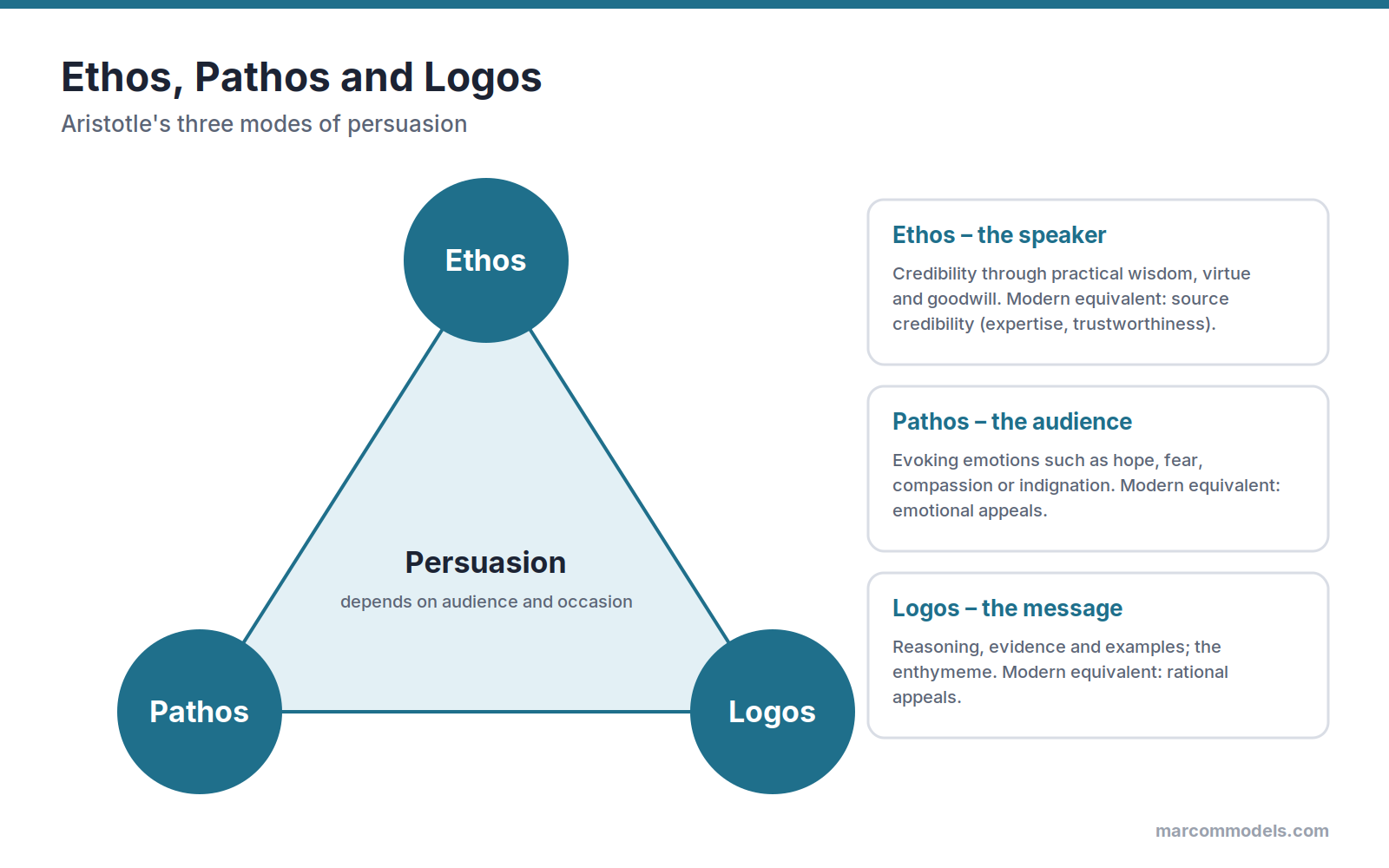
Aristotle distinguished three means of persuasion that the speaker creates through the speech itself (Aristotle, trans. 2007):
- Ethos – the character of the speaker. An audience is more easily persuaded by a speaker it considers credible. According to Aristotle, credibility comes from practical wisdom (phronesis), virtue (arete) and goodwill towards the audience (eunoia).
- Pathos – the emotions of the audience. Persuasion also depends on the emotional state of the audience. A speaker who evokes emotions such as indignation, fear, compassion or hope can influence how the audience judges an issue.
- Logos – the argument itself. Persuasion through reasoning, evidence, examples and logical conclusions. Aristotle emphasised the enthymeme: a reasoning in which the speaker leaves a premise unspoken because the audience fills it in.
Aristotle stressed that effective persuasion usually combines all three and depends on the audience and the occasion. Later rhetoricians added the concept of kairos: the right moment for a message.
Connection to modern theory. The three modes have clear counterparts in marketing communication. Ethos corresponds to source credibility, which Hovland, Janis and Kelley (1953) related to expertise and trustworthiness. Pathos corresponds to emotional appeals, such as humour, fear appeals and warmth, and logos corresponds to rational appeals based on product information and arguments (De Pelsmacker et al., 2021). The Elaboration Likelihood Model (Petty & Cacioppo, 1986) adds that strong arguments (logos) work mainly when people are motivated and able to process them, while cues such as the attractiveness or expertise of the source (ethos) play a larger role when involvement is low.
Applications of Ethos, Pathos and Logos
Communication professionals use the three modes to analyse and improve persuasive texts and presentations. In media training, spokespersons learn to build credibility (ethos), show empathy (pathos) and present clear facts (logos), for example in a crisis interview.
In corporate storytelling, the modes help create a balanced story: a credible narrator, a recognisable human element and a solid factual basis. In advertising analysis, they show whether a campaign relies mainly on expert endorsement, emotion or product arguments. Higgins and Walker (2012) showed how companies use ethos, pathos and logos in social and environmental reports to persuade stakeholders of their legitimacy.
Criticism
The three categories overlap in practice. A moving personal story (pathos) can strengthen credibility (ethos), and statistics (logos) can evoke strong emotions. The distinction is therefore more useful as an analytical lens than as a strict classification.
The model is also speaker-centred and rooted in the context of ancient Greek public speaking. Modern communication is often dialogic and mediated, and audiences co-create meaning. Cultural differences influence which forms of credibility, emotion and reasoning are considered persuasive.
Misuse and Flaws Compared to Similar Models
- Manipulative pathos. Exaggerated fear appeals or emotional exploitation can persuade in the short term but damage trust. Research into fear appeals shows that fear without a clear, achievable solution often leads to avoidance rather than action.
- Borrowed or false ethos. Using fake experts, anonymous “specialists” or influencers without relevant expertise creates the appearance of credibility without its substance.
- Fallacies disguised as logos. Selective statistics, false dilemmas and misleading comparisons look like rational argumentation but are not. Critical audiences quickly see through them.
Conclusion
Ethos, pathos and logos remain a powerful and accessible framework for understanding persuasion. They help communication professionals build balanced, credible messages and help audiences recognise how they are being persuaded. Combined with modern insights on source credibility, emotional and rational appeals and the Elaboration Likelihood Model, Aristotle’s modes of persuasion are as relevant today as they were in ancient Athens.
References
Aristotle. (2007). On rhetoric: A theory of civic discourse (G. A. Kennedy, Trans.; 2nd ed.). Oxford University Press.
De Pelsmacker, P., Geuens, M., & Van den Bergh, J. (2021). Marketing communications: A European perspective (7th ed.). Pearson.
Higgins, C., & Walker, R. (2012). Ethos, logos, pathos: Strategies of persuasion in social/environmental reports. Accounting Forum, 36(3), 194–208.
Hovland, C. I., Janis, I. L., & Kelley, H. H. (1953). Communication and persuasion: Psychological studies of opinion change. Yale University Press.
Petty, R. E., & Cacioppo, J. T. (1986). Communication and persuasion: Central and peripheral routes to attitude change. Springer.