
Introduction
When a crisis strikes, an organisation has to decide quickly what to say and do. Should it apologise, explain, deny or compensate? Situational Crisis Communication Theory (SCCT), developed by W. Timothy Coombs, offers an evidence-based framework for this choice. The core idea is that the most effective crisis response depends on how much responsibility stakeholders attribute to the organisation for the crisis.
SCCT is one of the most widely used theories in crisis communication research and is discussed in corporate communication textbooks such as Cornelissen (2020). This article explains the theory, its applications and its limitations.
Overview of SCCT
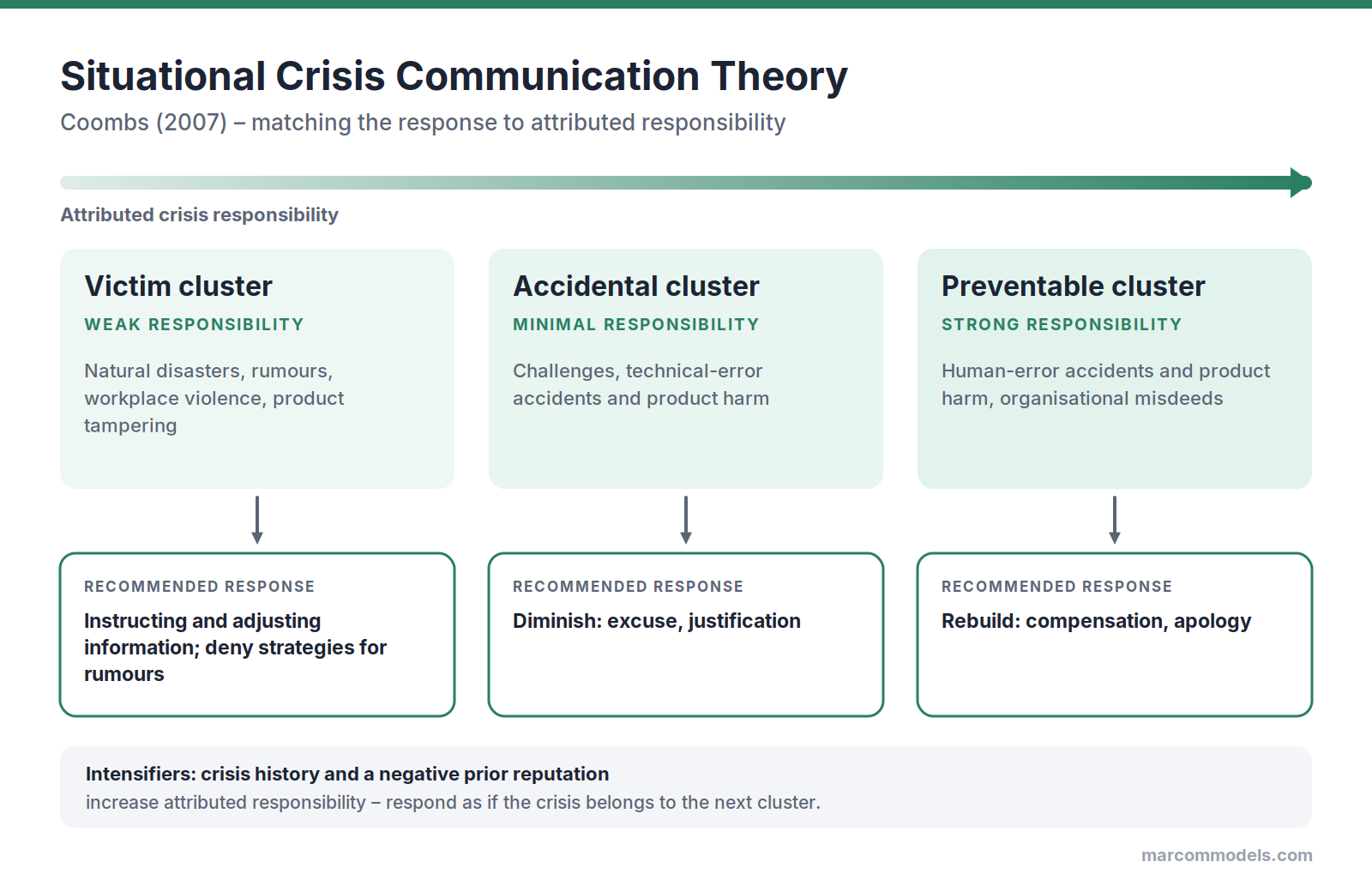
SCCT is based on attribution theory (Weiner, 1986): people look for the causes of events, and when they hold an organisation responsible for a negative event, they react with anger and a more negative attitude. SCCT follows three steps (Coombs, 2007).
Step 1: Determine the crisis type. Crisis types are grouped into three clusters based on attributed responsibility:
- Victim cluster (weak responsibility): natural disasters, rumours, workplace violence, product tampering or malevolence by outsiders.
- Accidental cluster (minimal responsibility): challenges by stakeholders, technical-error accidents, technical-error product harm.
- Preventable cluster (strong responsibility): human-error accidents, human-error product harm, organisational misdeeds.
Step 2: Consider the intensifiers. Two factors increase attributed responsibility: a crisis history (similar crises in the past) and a negative prior reputation. A crisis in the accidental cluster is then treated as if it were preventable.
Step 3: Choose a response strategy. Before anything else, the organisation provides instructing information (what stakeholders should do to protect themselves) and adjusting information (expressing concern, explaining corrective action). Then SCCT distinguishes:
- Deny strategies: attacking the accuser, denial, scapegoating.
- Diminish strategies: excuse (minimising responsibility), justification (minimising the damage).
- Rebuild strategies: compensation, apology.
- Bolstering strategies (supplementary): reminding stakeholders of past good works, ingratiation (praising stakeholders), victimage.
The general recommendation is that the response should match the level of responsibility: instructing and adjusting information may suffice in the victim cluster, diminish strategies fit the accidental cluster, and rebuild strategies are needed in the preventable cluster or when intensifiers are present. Deny strategies are only appropriate for rumours and unjustified challenges.
Related theory. Benoit’s (1997) image restoration theory offers a similar typology: denial, evasion of responsibility, reducing offensiveness, corrective action and mortification (apology). SCCT differs in that it links strategies explicitly to crisis types.
Applications of SCCT
SCCT is used in crisis plans, crisis simulations and the evaluation of real crisis responses. It helps communication teams make well-founded decisions under time pressure and explain those decisions to management and legal advisers.
Coombs and Holladay (2012) extended the theory to the social media environment with the concept of the paracrisis: a publicly visible threat, such as online criticism, that can escalate into a crisis if handled badly. SCCT is also closely related to issues management: many crises are issues that were not recognised in time.
Criticism
Much SCCT research is based on experiments with fictional crisis scenarios and student participants, which raises questions about how well the findings translate to real crises with real stakeholders.
The theory has also been criticised for focusing mainly on protecting the organisation’s reputation, while ethical considerations – what the organisation owes to victims – may be more important. Cultural differences play a role as well: the meaning and legal consequences of an apology differ between countries. Finally, the fast, fragmented dynamics of crises on social media make it hard to determine the crisis type and “right” response in advance.
Misuse and Flaws Compared to Similar Theories
- Using SCCT as a formula. The theory offers guidelines, not an algorithm. Every crisis requires judgement about context, stakeholders and ethics.
- Apologising without substance. An apology without corrective action and compensation is quickly perceived as insincere and can worsen the crisis.
- Using scapegoating or denial when the organisation is responsible. Deny strategies in the preventable cluster almost always backfire once the facts become known.
Conclusion
SCCT offers a clear and well-researched framework for crisis communication. By linking crisis types, attributed responsibility and reputation to response strategies, it helps organisations respond appropriately under pressure. Its central lesson is that the more responsibility stakeholders attribute to the organisation, the more the organisation must do to take responsibility and repair the damage.
References
Benoit, W. L. (1997). Image repair discourse and crisis communication. Public Relations Review, 23(2), 177–186.
Coombs, W. T. (2007). Protecting organization reputations during a crisis: The development and application of situational crisis communication theory. Corporate Reputation Review, 10(3), 163–176.
Coombs, W. T., & Holladay, S. J. (2002). Helping crisis managers protect reputational assets: Initial tests of the situational crisis communication theory. Management Communication Quarterly, 16(2), 165–186.
Coombs, W. T., & Holladay, S. J. (2012). The paracrisis: The challenges created by publicly managing crisis prevention. Public Relations Review, 38(3), 408–415.
Cornelissen, J. (2020). Corporate communication: A guide to theory and practice (6th ed.). Sage.
Weiner, B. (1986). An attributional theory of motivation and emotion. Springer.