
Introduction
An issue is a development or question on which an organisation and (some of) its stakeholders hold different views, and which may affect the organisation’s operations or reputation. Examples include debates about plastic packaging, working conditions in supply chains or the privacy of customer data. Issues management is the process of identifying such issues early and responding to them strategically (Cornelissen, 2020).
A central idea in issues management is that issues go through a life cycle. The later an organisation responds, the less influence it has over the outcome. This article discusses the best-known issue life cycle models, their applications and their limitations.
Overview of the Issue Life Cycle
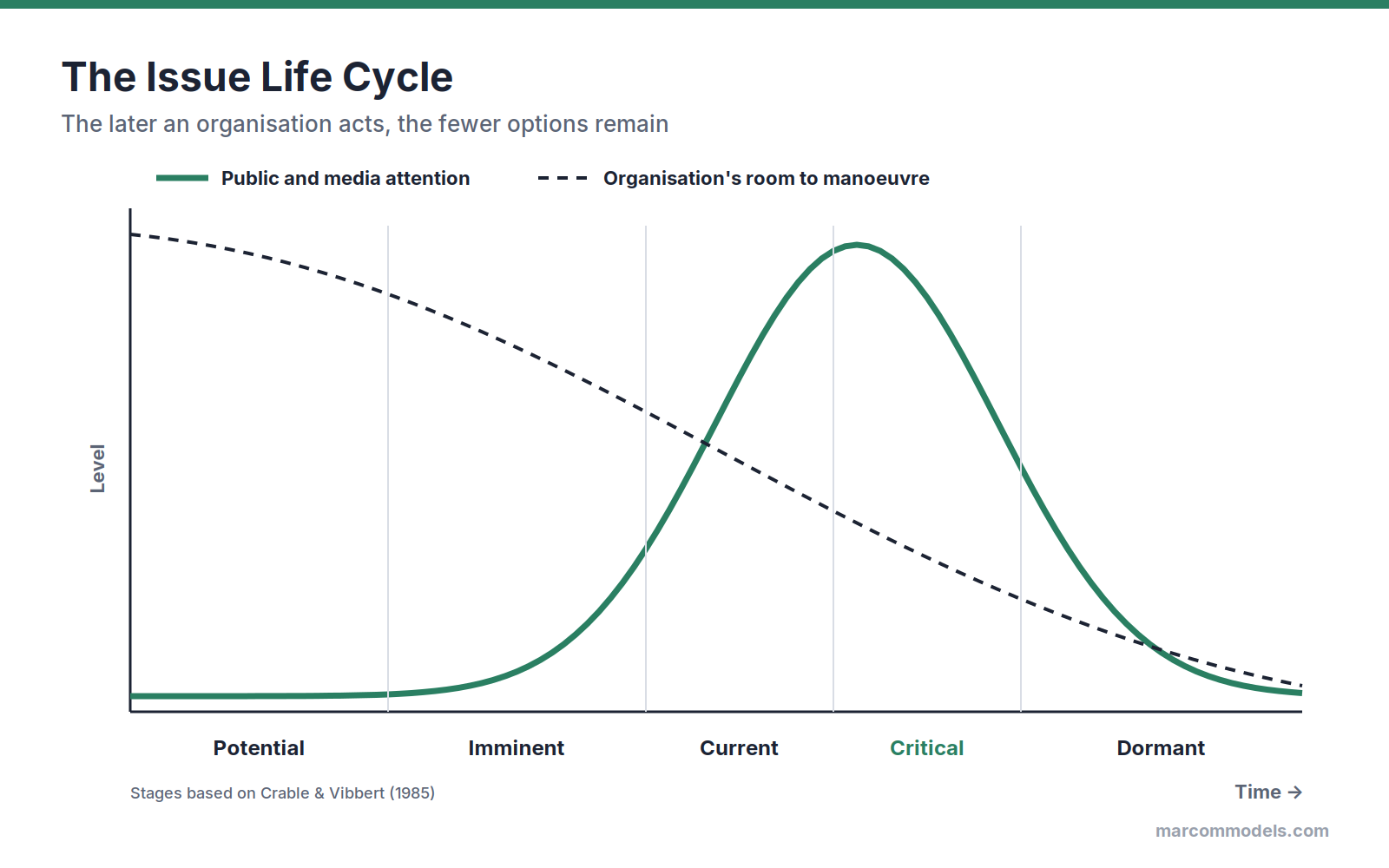
Crable and Vibbert (1985) describe five stages, or statuses, of an issue:
- Potential – an individual or group shows interest in a topic, but it is not yet widely discussed.
- Imminent – the topic gains legitimacy and others begin to recognise it as relevant.
- Current – the issue receives media attention and becomes part of public debate.
- Critical – the issue reaches a point of decision, for example new legislation or a boycott; people take sides.
- Dormant – the issue seems resolved or disappears from attention, but it can resurface later.
Hainsworth (1990) describes a comparable cycle with four stages: origin (a trend or event creates a potential issue), mediation and amplification (interest groups and media take up the issue), organisation (publics organise and pressure increases) and resolution (the issue is settled, for example through regulation).
Decreasing room to manoeuvre. Both models show the same core principle: in the early stages the organisation has many strategic options, while public attention is still low. As the issue progresses, the options decrease and other parties – media, activists, politicians – increasingly determine the agenda. By the time an issue becomes critical, the organisation is mainly reacting.
The issues management process. Chase (1984) proposed a process of issue identification, issue analysis, choosing a change strategy, action planning and evaluation. Organisations prioritise issues based on the likelihood that they will develop and their potential impact on the organisation.
Applications of the Issue Life Cycle
The issue life cycle is used in environmental monitoring, for example through media monitoring, social listening and sentiment analysis. By determining in which stage an issue is, organisations can choose a suitable strategy: adapting their own policy early, entering into dialogue with stakeholders, or participating in the public debate.
The model is closely related to stakeholder analysis (such as the power-interest matrix and the stakeholder salience model), to agenda-setting and framing, and to crisis communication: an issue that is ignored can develop into a crisis.
Criticism
The life cycle models suggest a gradual, linear development. In a social media environment, issues can move from potential to critical within hours, skipping stages altogether. Dormant issues can also be reactivated suddenly by a new incident.
Identifying issues in the potential stage is difficult: weak signals are easily missed or dismissed, and organisations tend to underestimate issues that conflict with their own views. In addition, issues management has been criticised when organisations use it mainly to influence public policy in their own favour rather than to adjust their behaviour to societal expectations (Heath & Palenchar, 2009).
Misuse and Flaws Compared to Similar Models
- Using issues management only for defence. The aim is not to make issues disappear, but to align the organisation with societal expectations. Sometimes the best response is to change the organisation’s own behaviour.
- Waiting until an issue is current. Many organisations only respond once there is media attention, when the room to manoeuvre is already limited.
- Ignoring dormant issues. An issue that seems resolved can quickly return. Monitoring should continue after the peak of attention.
Conclusion
The issue life cycle shows that issues develop in stages and that an organisation’s influence decreases as an issue matures. Although real issues rarely follow a neat, linear path – especially online – the model helps organisations monitor their environment and act early. Its most important lesson is simple: the earlier an issue is recognised, the more options remain.
References
Chase, W. H. (1984). Issue management: Origins of the future. Issue Action Publications.
Cornelissen, J. (2020). Corporate communication: A guide to theory and practice (6th ed.). Sage.
Crable, R. E., & Vibbert, S. L. (1985). Managing issues and influencing public policy. Public Relations Review, 11(2), 3–16.
Hainsworth, B. E. (1990). The distribution of advantages and disadvantages. Public Relations Review, 16(1), 33–39.
Heath, R. L., & Palenchar, M. J. (2009). Strategic issues management: Organizations and public policy challenges (2nd ed.). Sage.