
Introduction
A red rose, a logo, a colour, a gesture, a photograph of a family at a breakfast table: all of these are signs that carry meaning. Semiotics is the study of signs and how they create meaning. For communication professionals, semiotics offers tools to analyse and design visual and verbal messages – from advertisements and logos to packaging and social media content.
Three thinkers are central to semiotics in communication studies: the Swiss linguist Ferdinand de Saussure, the American philosopher Charles Sanders Peirce and the French theorist Roland Barthes. This article explains their key concepts and shows how they are used in advertising and branding.
Overview of Semiotics
Saussure: signifier and signified. Saussure (1916/1983) described the sign as a combination of a signifier (the form, such as a word or image) and a signified (the concept it refers to). The relationship between the two is arbitrary: there is no natural reason why the word “tree” refers to a tree. Meaning arises from convention and from differences between signs.
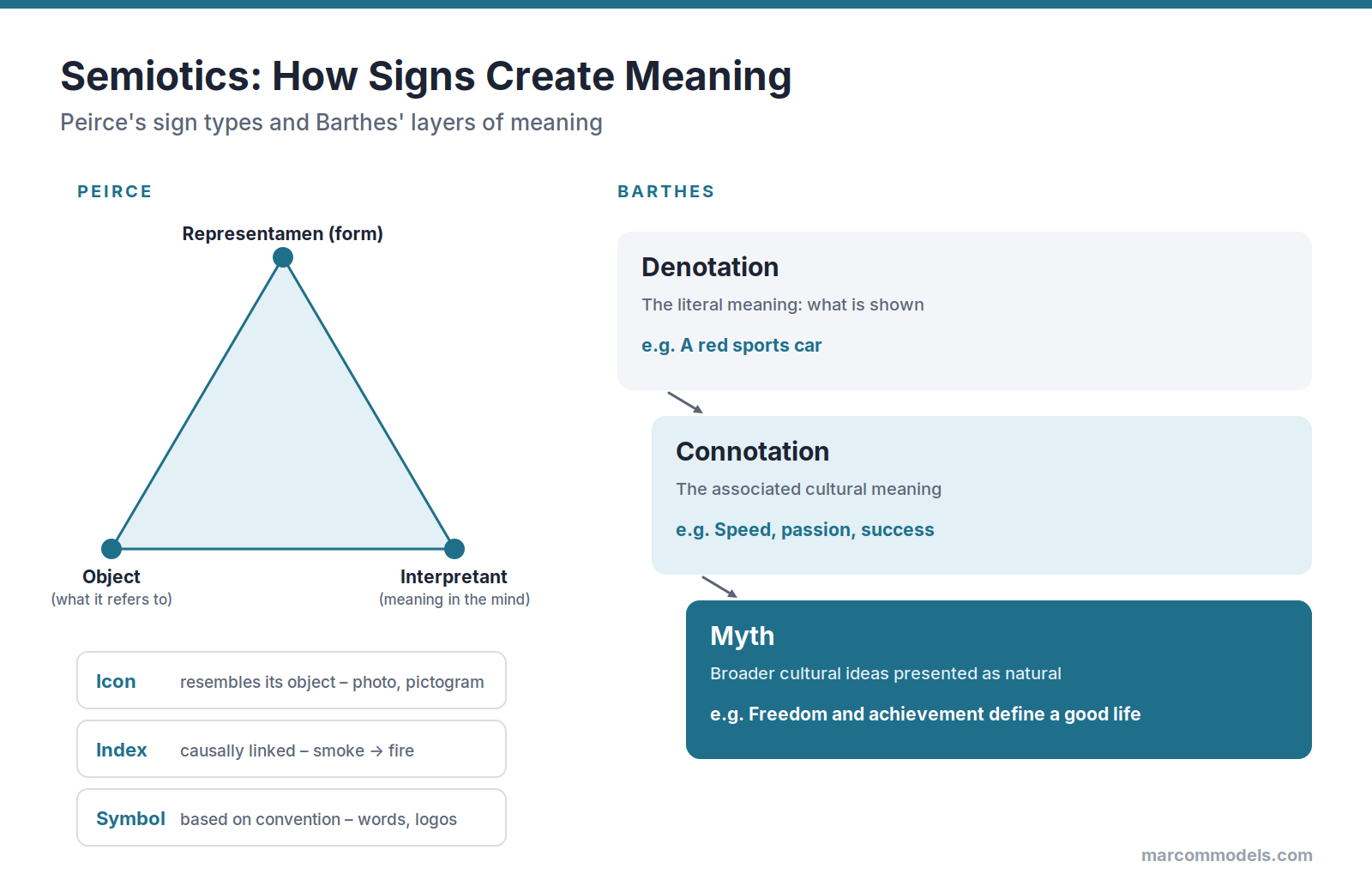
Peirce: three types of signs. Peirce described a sign as a relationship between three elements: the representamen (the form of the sign), the object (what it refers to) and the interpretant (the meaning formed in the mind of the interpreter). He distinguished three types of signs based on the relationship between sign and object:
- Icon – the sign resembles its object, such as a photograph, a portrait or a pictogram.
- Index – the sign is causally or physically connected to its object, such as smoke indicating fire, or a footprint indicating a person.
- Symbol – the relationship is based on convention and must be learned, such as words, flags or logos.
Barthes: denotation, connotation and myth. Barthes (1957/1972, 1977) showed how signs carry layers of meaning:
- Denotation – the literal meaning: what is visibly shown. A photo shows a red sports car.
- Connotation – the associated cultural meaning: the red sports car connotes speed, passion, success or freedom.
- Myth – broader cultural ideas and ideologies that connotations reinforce, presenting them as natural and self-evident.
In his famous analysis of an advertisement for Panzani pasta, Barthes showed how images of fresh vegetables and the colours green, white and red connote “Italianicity”. He also described how text relates to an image: anchorage (text fixes the intended meaning of the image) and relay (text and image complement each other).
Applications of Semiotics
In advertising and branding, semiotics is used to analyse how campaigns create meaning and to design messages that evoke the desired associations. Brand identity elements – name, logo, colours, typography – are signs whose connotations should fit the brand (see the corporate identity mix). Semiotic analysis is also used in consumer research to understand cultural codes in a category (Mick, 1986).
For students, semiotics is a method to “learn to look”: to analyse images step by step, from what is denoted to what is connoted and which myths are reinforced. It is also useful in international communication, as the same sign can carry different connotations in different cultures (see Hall’s iceberg model).
Criticism
Semiotic analysis is interpretive and depends on the knowledge and perspective of the analyst. Different analysts may attribute different connotations to the same sign, and there is no easy way to test which interpretation is “correct”. Actual audiences may read messages in ways the analyst did not anticipate.
The terminology of semiotics is also complex, and different schools use terms in different ways. Critics argue that semiotic analysis can become overly abstract and disconnected from how people actually process messages – often quickly and superficially.
Misuse and Flaws Compared to Similar Approaches
- Presenting one interpretation as the truth. Semiotic analysis should be substantiated and, where possible, checked with audience research.
- Ignoring cultural context. Connotations are culturally specific; a colour or gesture can mean something very different elsewhere.
- Stopping at denotation. Describing what is visible without analysing connotation and myth misses the core of semiotic analysis.
Conclusion
Semiotics offers a powerful set of concepts for understanding how communication creates meaning. Saussure’s signifier and signified, Peirce’s icon, index and symbol, and Barthes’ denotation, connotation and myth help communication professionals analyse and design messages consciously. Used critically and with attention to context and audiences, semiotics sharpens the eye for the many layers of meaning in everyday communication.
References
Barthes, R. (1972). Mythologies (A. Lavers, Trans.). Hill and Wang. (Original work published 1957)
Barthes, R. (1977). Rhetoric of the image. In Image, music, text (S. Heath, Trans., pp. 32–51). Fontana.
Chandler, D. (2017). Semiotics: The basics (3rd ed.). Routledge.
Mick, D. G. (1986). Consumer research and semiotics: Exploring the morphology of signs, symbols, and significance. Journal of Consumer Research, 13(2), 196–213.
Saussure, F. de (1983). Course in general linguistics (R. Harris, Trans.). Duckworth. (Original work published 1916)