
Introduction
Anyone who travels abroad or works in an international team notices differences in language, food, greetings and dress. These are the visible aspects of culture. But the most important differences – in values, beliefs and ways of thinking – cannot be seen directly, and they cause most intercultural misunderstandings.
The iceberg model of culture illustrates this idea. It is commonly attributed to the American anthropologist Edward T. Hall, one of the founders of intercultural communication as a field, and his book Beyond Culture (1976). The iceberg image itself was popularised later in intercultural training. This article explains the model, Hall’s related concepts, and its applications and limitations.
Overview of the Iceberg Model
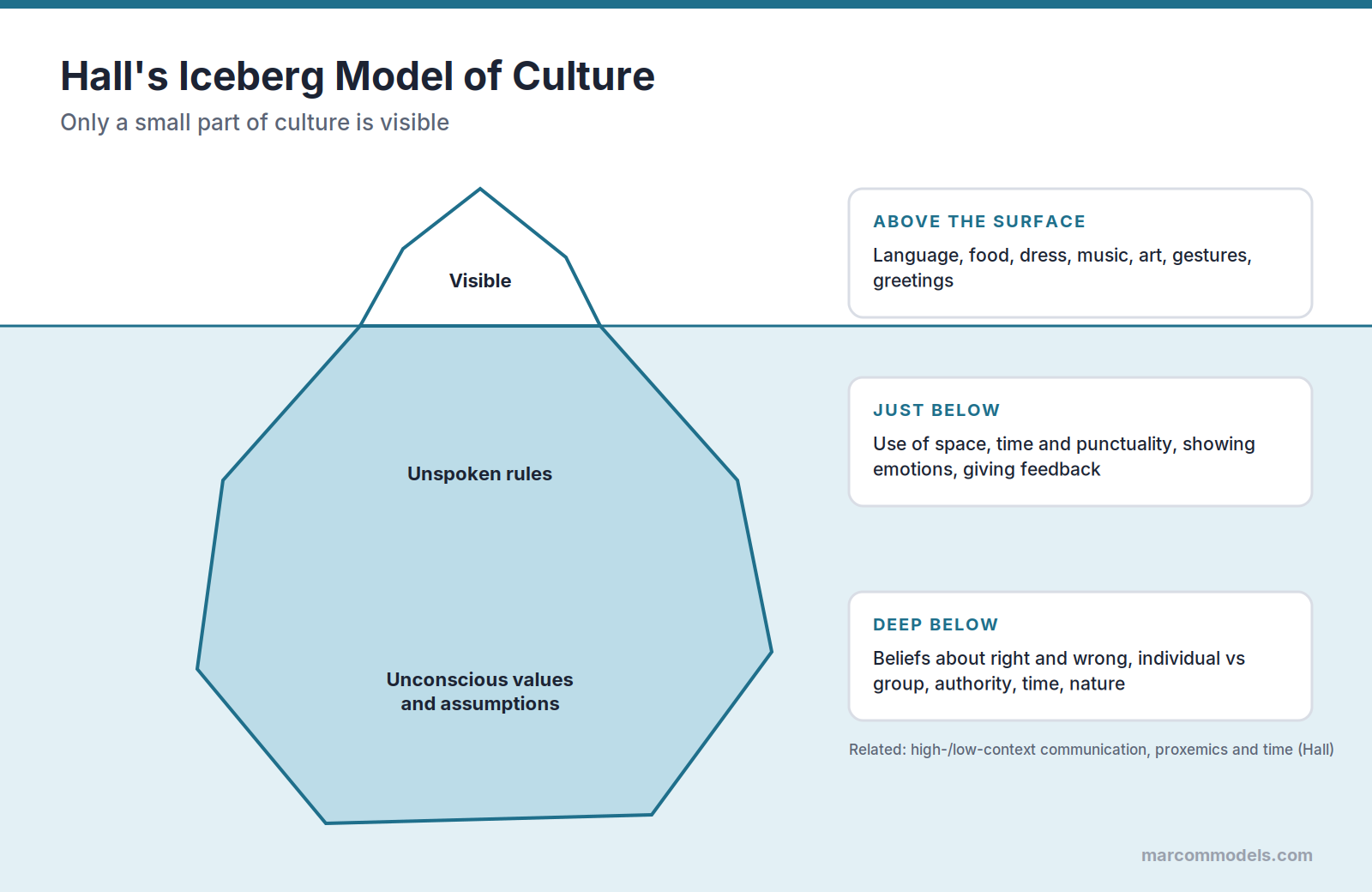
Like an iceberg, culture has a small visible part above the waterline and a much larger invisible part below:
- Above the surface: visible culture. Behaviour and artefacts that can be observed directly: language, food, dress, music, art, gestures, greetings and customs. People are generally aware of these differences.
- Just below the surface: unspoken rules. Norms that people follow without thinking about them explicitly, such as how close to stand to someone, how to handle time and punctuality, when it is appropriate to show emotions, and how to give feedback.
- Deep below the surface: unconscious values and assumptions. Deeply held beliefs about what is right and wrong, the role of the individual versus the group, attitudes towards authority, and fundamental ideas about time, nature and human relationships.
The lesson of the model is that visible behaviour is driven by invisible values and assumptions. Just as the largest part of an iceberg can sink a ship, the invisible part of culture causes the most serious misunderstandings.
Hall’s related concepts. Hall contributed several concepts that describe the invisible part of culture:
- High-context and low-context communication (Hall, 1976). In high-context cultures, much of the meaning is conveyed through context, relationships and non-verbal signals. In low-context cultures, meaning is expressed explicitly in words.
- Proxemics (Hall, 1966) – the culturally determined use of space and personal distance.
- Monochronic and polychronic time (Hall, 1983) – doing one thing at a time and valuing schedules, versus doing many things at once and valuing relationships over schedules.
The iceberg model resembles other layered models of culture, such as Trompenaars’ onion model.
Applications of the Iceberg Model
The iceberg model is one of the most widely used tools in intercultural training and education. It helps people recognise that their first impressions of another culture are based on the visible tip, and encourages them to ask questions about underlying values before drawing conclusions.
In international communication, marketing and management, the model supports reflection on why messages are interpreted differently in different cultures. The concepts of high- and low-context communication are particularly useful for adapting the style of messages, meetings and negotiations. The model also invites reflection on one’s own culture: what seems “normal” is often part of one’s own invisible iceberg.
Criticism
The model is a metaphor rather than a tested theory. It does not specify exactly which elements belong to which level, and different versions of the iceberg place elements differently. The attribution to Hall is also debated, as the iceberg image does not appear in this form in his original work.
Like other models of national culture, the iceberg can lead to a static and homogeneous view of culture, while cultures change and individuals differ widely within them. The high-/low-context distinction has been criticised for limited empirical support and for being applied too generally to whole countries.
Misuse and Flaws Compared to Similar Models
- Using the model to stereotype. The iceberg describes culture in general; it does not tell you what an individual thinks or values.
- Assuming that visible similarities mean shared values. People may dress and speak alike while holding very different values.
- Ignoring one’s own iceberg. Intercultural communication starts with awareness of one’s own invisible assumptions, not only those of others.
Conclusion
The iceberg model of culture offers a simple and memorable way to show that the most important aspects of culture are invisible. Combined with Hall’s concepts of high- and low-context communication, proxemics and time, it helps communication professionals and students look beneath the surface of intercultural encounters. Its value lies in encouraging curiosity and reflection rather than in categorising people.
References
Hall, E. T. (1966). The hidden dimension. Doubleday.
Hall, E. T. (1976). Beyond culture. Anchor Press/Doubleday.
Hall, E. T. (1983). The dance of life: The other dimension of time. Anchor Press/Doubleday.
Hofstede, G., Hofstede, G. J., & Minkov, M. (2010). Cultures and organizations: Software of the mind (3rd ed.). McGraw-Hill.