
Introduction
Corporate reputation is one of the most valuable intangible assets of an organisation. A strong reputation makes customers more willing to buy, employees more willing to work for the organisation and stakeholders more willing to give it the benefit of the doubt in times of crisis. But how can something as intangible as reputation be measured?
The best-known answers come from Charles Fombrun and Cees van Riel, founders of the Reputation Institute. Their Reputation Quotient and its successor, the RepTrak model, are widely used in research and practice and are discussed in corporate communication textbooks such as Cornelissen (2020) and Van Riel and Fombrun (2007).
Overview of the Reputation Quotient and RepTrak
Defining reputation. Fombrun (1996) describes corporate reputation as the overall perception of a company’s past actions and future prospects, and its overall appeal to stakeholders compared with its competitors. Reputation is collective and built up over time, which distinguishes it from the more immediate corporate image.
The Reputation Quotient. Fombrun, Gardberg and Sever (2000) developed the Reputation Quotient (RQ), which measures reputation using twenty attributes grouped into six dimensions:
- Emotional appeal
- Products and services
- Vision and leadership
- Workplace environment
- Financial performance
- Social and environmental responsibility
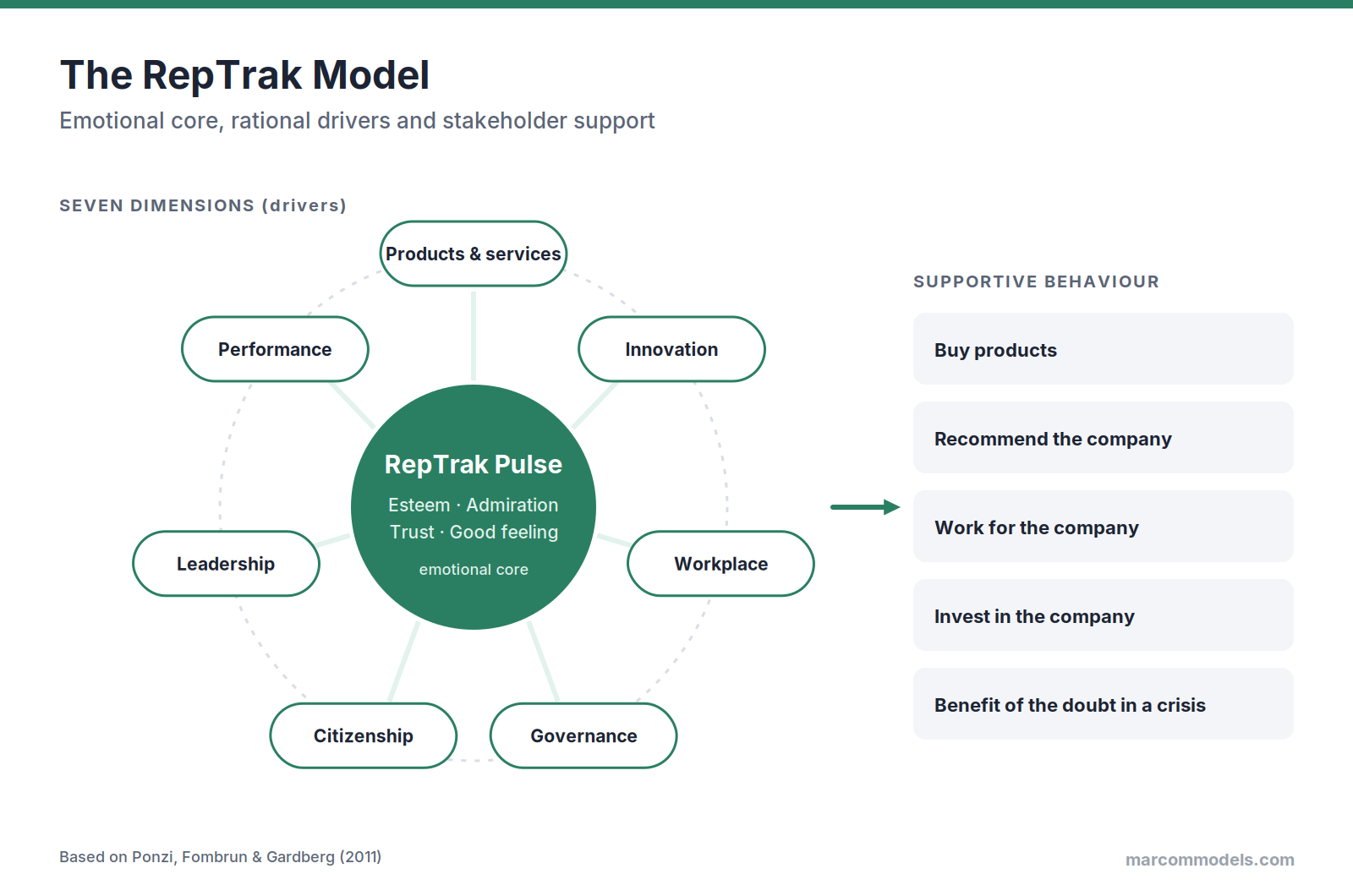
The RepTrak model. RepTrak further developed this approach. At its core is the RepTrak Pulse, an emotional measure of reputation based on four attributes: esteem, admiration, trust and good feeling (Ponzi, Fombrun & Gardberg, 2011). Around this core, the model distinguishes seven rational dimensions, or drivers, measured through 23 attributes:
- Products and services – quality, value for money, meeting customer needs
- Innovation – innovativeness, first to market, adapting quickly to change
- Workplace – rewarding employees, concern for employee wellbeing, equal opportunities
- Governance – openness and transparency, ethical behaviour, fairness
- Citizenship – environmental responsibility, supporting good causes, positive influence on society
- Leadership – strong leaders, clear vision, good organisation
- Performance – profitability, strong prospects for future growth
A strong reputation results in supportive behaviour from stakeholders, such as buying products, recommending the company, working for it, investing in it and giving it the benefit of the doubt in a crisis.
Applications of the Reputation Models
Organisations use RepTrak and similar measurements to benchmark their reputation against competitors, to identify which dimensions drive their reputation most among specific stakeholder groups, and to monitor developments over time. Annual reputation rankings, including national studies of the largest companies in the Netherlands, attract a great deal of media attention.
For communication professionals, the most useful insight is often the analysis of drivers: which dimensions have the greatest impact on the emotional core? This shows where the organisation should focus its behaviour and communication. The models also link reputation management to issue management, stakeholder management and employer branding.
Criticism
The RepTrak model is a proprietary, commercial instrument, which limits transparency about its methodology and independent scientific validation. Schwaiger (2004) argues that reputation consists of both a cognitive component (competence) and an affective component (sympathy), and that these should be measured separately rather than combined into one score.
Reputation measurements among the general public also say little about the reputation among specific stakeholders, such as regulators or employees, whose support may be more important. Finally, scores may be influenced by familiarity and halo effects: well-known companies often score well on dimensions that respondents know little about.
Misuse and Flaws Compared to Similar Models
- Treating the score as the goal. Reputation is a result of behaviour and relationships. Organisations that focus only on improving a ranking risk superficial measures.
- Trying to fix reputation with communication alone. Reputation is largely determined by performance and behaviour. Communication can make good behaviour visible, but cannot compensate for poor behaviour in the long term.
- Comparing scores from different methods. RQ, RepTrak and other reputation measures use different dimensions and scales; their results are not directly comparable.
Conclusion
The Reputation Quotient and the RepTrak model have made the intangible concept of corporate reputation measurable and manageable. By distinguishing an emotional core, rational drivers and supportive behaviours, they show how reputation arises and what it yields. Used critically, and combined with stakeholder-specific research, they are valuable tools for strategic reputation management.
References
Cornelissen, J. (2020). Corporate communication: A guide to theory and practice (6th ed.). Sage.
Fombrun, C. J. (1996). Reputation: Realizing value from the corporate image. Harvard Business School Press.
Fombrun, C. J., Gardberg, N. A., & Sever, J. M. (2000). The Reputation Quotient: A multi-stakeholder measure of corporate reputation. Journal of Brand Management, 7(4), 241–255.
Ponzi, L. J., Fombrun, C. J., & Gardberg, N. A. (2011). RepTrak Pulse: Conceptualizing and validating a short-form measure of corporate reputation. Corporate Reputation Review, 14(1), 15–35.
Schwaiger, M. (2004). Components and parameters of corporate reputation: An empirical study. Schmalenbach Business Review, 56(1), 46–71.
Van Riel, C. B. M., & Fombrun, C. J. (2007). Essentials of corporate communication: Implementing practices for effective reputation management. Routledge.