
Introduction
When people from different cultures work together, misunderstandings often arise that cannot be explained by language alone. Why do colleagues from one country value punctuality so much, while others prioritise relationships? Why do some people give direct feedback while others avoid it? To understand such differences, it helps to look beyond what is visible.
The Dutch organisational theorist Fons Trompenaars and the British management philosopher Charles Hampden-Turner described culture as an onion consisting of layers (Trompenaars & Hampden-Turner, 1997). The model is used in intercultural communication and research to analyse culture systematically, from the visible outside to the invisible core.
Overview of the Onion Model
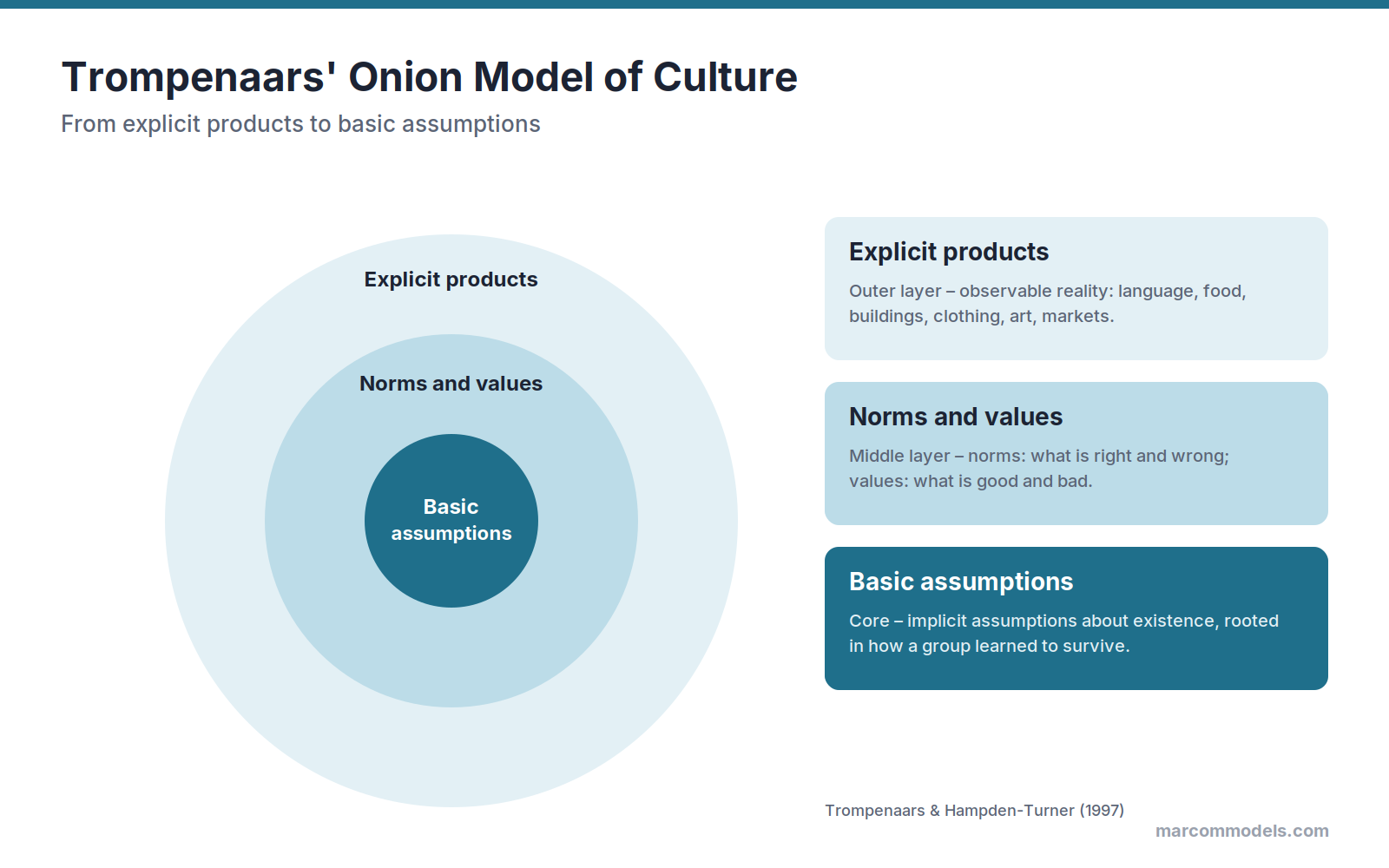
According to Trompenaars and Hampden-Turner, culture consists of three layers:
- Outer layer: explicit products. The observable reality of a culture: language, food, buildings, clothing, art, markets and technology. These are the first things people notice when they encounter another culture. Explicit products are expressions of deeper layers.
- Middle layer: norms and values. Norms are the shared sense of what is “right” and “wrong”; they can be formal (laws) or informal (social control). Values determine what is considered “good” and “bad” and reflect the ideals of a group. A culture is relatively stable when its norms reflect its values.
- Core: basic assumptions about existence. The deepest layer consists of implicit, unquestioned assumptions. According to the authors, they stem from the way a group has learned to solve problems of survival in its environment. Because they have become self-evident, people are rarely aware of them.
Seven dimensions. Trompenaars and Hampden-Turner also distinguish seven dimensions on which cultures differ, based on how they deal with relationships with people, time and the environment: universalism vs particularism, individualism vs communitarianism, specific vs diffuse, neutral vs affective, achievement vs ascription, sequential vs synchronic time, and internal vs external control.
Similar models. Hofstede also describes culture with an onion model, with symbols, heroes and rituals as “practices” around a core of values (Hofstede, Hofstede & Minkov, 2010). Schein (2010) uses a comparable division into artefacts, espoused values and basic underlying assumptions for organisational culture (see organisational culture models), and Hall’s iceberg model uses the metaphor of visible and invisible culture.
Applications of the Onion Model
The onion model is used in intercultural research and training to look beneath visible behaviour. By starting with the observable outer layer and asking why certain behaviour or products exist, one can gradually uncover norms, values and basic assumptions – for example through participant observation and interviews.
In international communication and marketing, the model helps to understand why a campaign that works in one country may be misunderstood in another. In international teams, it supports reflection on one’s own cultural assumptions before judging those of others.
Criticism
The model treats cultures, often national cultures, as relatively homogeneous and stable entities. In reality, cultures are dynamic and people belong to several cultures at the same time: national, regional, professional and generational.
The layers are also difficult to separate in practice, and the core of basic assumptions can hardly be observed or measured directly. The seven dimensions have been criticised for their methodology and for reinforcing stereotypes when applied to individuals.
Misuse and Flaws Compared to Similar Models
- Stereotyping individuals. The model describes patterns at group level; it does not predict how an individual will behave.
- Stopping at the outer layer. Describing food, clothing and greetings without analysing underlying norms and values misses the point of the model.
- Using one’s own culture as the norm. The model is meant to understand differences, not to judge other cultures by one’s own standards.
Conclusion
Trompenaars’ onion model offers a clear way to analyse culture from the visible outside to the invisible core. By distinguishing explicit products, norms and values, and basic assumptions, it helps communication professionals and researchers understand the deeper causes of cultural differences. Used with care – as a lens rather than a label – it is a valuable tool for intercultural communication.
References
Hofstede, G., Hofstede, G. J., & Minkov, M. (2010). Cultures and organizations: Software of the mind (3rd ed.). McGraw-Hill.
Schein, E. H. (2010). Organizational culture and leadership (4th ed.). Jossey-Bass.
Trompenaars, F., & Hampden-Turner, C. (1997). Riding the waves of culture: Understanding cultural diversity in business (2nd ed.). Nicholas Brealey.