
Introduction
Organisations operate in an environment they cannot control but must respond to. An ageing population, rising interest rates, new privacy legislation or the rise of generative AI can all create opportunities or threats. DESTEP analysis is a structured way to map these developments in the macro-environment.
The model is widely used in Dutch and Belgian marketing and communication education – for example in Verhage’s Marketing Fundamentals – and is closely related to the internationally better-known PEST and PESTEL analyses. This article explains the six factors, how to carry out a DESTEP analysis and what its limitations are.
Overview of DESTEP Analysis
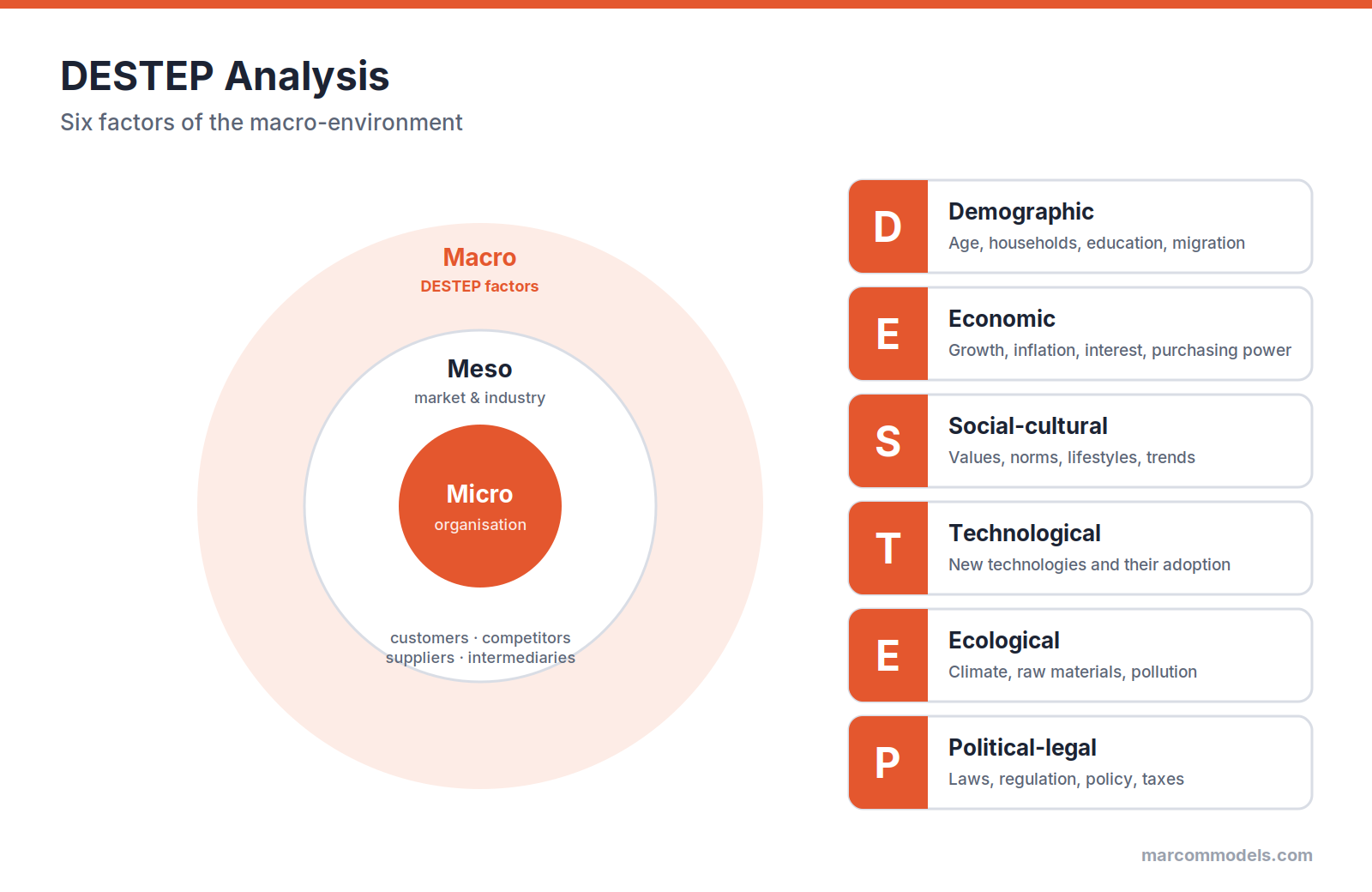
The environment of an organisation is usually divided into three levels (see Market Environment (Micro, Meso, Macro)):
- the micro-environment: the organisation itself;
- the meso-environment: the market or industry, including customers, competitors, suppliers and intermediaries (compare Porter’s Five Forces);
- the macro-environment: broad societal developments that affect all organisations in a market and which a single organisation can hardly influence.
DESTEP focuses on the macro-environment and distinguishes six groups of factors:
- Demographic – size and composition of the population: age, household composition, education, migration, urbanisation.
- Economic – economic growth, inflation, interest rates, unemployment, purchasing power and exchange rates.
- Social-cultural – values, norms, lifestyles and trends, such as attitudes towards sustainability, health or work–life balance.
- Technological – new technologies and their adoption, such as artificial intelligence, mobile payments or automation.
- Ecological – the natural environment: climate change, scarcity of raw materials, pollution and the resulting expectations of consumers.
- Political-legal – legislation, regulation and government policy, such as taxes, subsidies, advertising rules and privacy law.
Relation to PEST and PESTEL. The idea of scanning the macro-environment goes back to Aguilar (1967), who distinguished economic, technical, political and social factors (ETPS). This later became PEST. PESTEL adds environmental and legal factors. DESTEP covers largely the same ground, but gives demographic factors a separate place and combines political and legal factors. The models are therefore variants of the same approach rather than extensions of one another.
Applications of DESTEP Analysis
A DESTEP analysis is usually carried out in five steps:
- Define the scope: for which organisation, market and time horizon is the analysis made?
- Scan each factor using reliable sources such as statistical offices (for example CBS in the Netherlands), trend reports, industry studies and news.
- Describe developments, not just facts: “the share of people over 65 is growing” says more than “17% of the population is over 65”.
- Assess the impact: how likely is each development, and how strongly does it affect the organisation?
- Translate the results into opportunities and threats, which then serve as input for a SWOT analysis and strategic choices.
In marketing communication, a DESTEP analysis helps to identify relevant trends for campaigns, to anticipate changes in target groups and media use, and to recognise developing societal issues at an early stage (see the issue life cycle).
Criticism
DESTEP is essentially a checklist. It helps to structure an analysis, but it does not explain how factors influence each other or how to prioritise them. Many developments – such as the energy transition – are simultaneously economic, technological, ecological and political, and the division into six categories can obscure these connections.
The analysis also tends to be a snapshot of the present, while the macro-environment changes continuously. Finally, the quality of the analysis depends heavily on the sources used and on the judgement of the analyst, which makes it vulnerable to bias and to selecting information that confirms existing views.
Misuse and Flaws Compared to Similar Models
- Listing facts without implications. A long list of statistics without the question “what does this mean for us?” has little strategic value.
- Mixing up environmental levels. Competitors, customers and suppliers belong to the meso-environment, not in a DESTEP analysis.
- Treating it as a one-off exercise. Useful environmental analysis is continuous; developments should be monitored and the analysis updated regularly.
- Confusing the variants. DESTEP, PEST and PESTEL cover largely the same factors. Choose one model and apply it consistently, rather than presenting them as fundamentally different tools.
Conclusion
DESTEP analysis offers a clear framework for mapping the macro-environment of an organisation. By systematically examining demographic, economic, social-cultural, technological, ecological and political-legal developments, organisations can identify opportunities and threats early. Its value lies not in the list itself, but in translating developments into implications and strategic choices.
References
Aguilar, F. J. (1967). Scanning the business environment. Macmillan.
Fahey, L., & Narayanan, V. K. (1986). Macroenvironmental analysis for strategic management. West Publishing.
Johnson, G., Whittington, R., Regnér, P., Angwin, D., & Scholes, K. (2020). Exploring strategy: Text and cases (12th ed.). Pearson.
Verhage, B., & Visser, M. (2023). Marketing fundamentals: An international perspective (4th ed.). Noordhoff.