
Introduction
Many communication campaigns assume that people will change their behaviour once they know enough and have the right attitude. This is the basis of the hierarchy-of-effects model. In practice, there is a gap between knowing something, wanting it and actually doing it. People are often led more by emotion, habit and the people around them than by a rational assessment of costs and benefits, and much of our behaviour runs on automatic pilot.
The Communication Activation Strategy Instrument (CASI) was developed to apply these behavioural insights in communication. It was created by the Public Information and Communications Service (Dienst Publiek en Communicatie, DPC) of the Dutch Ministry of General Affairs and is widely used in Dutch public communication and in communication education. An English version is available: the CASI Facilitator’s guide, which includes worksheets, a helpsheet on the behavioural determinants and intervention cards (DPC, 2021). This article explains the six steps, the nine behavioural determinants and the eight intervention strategies of CASI.
Overview of CASI
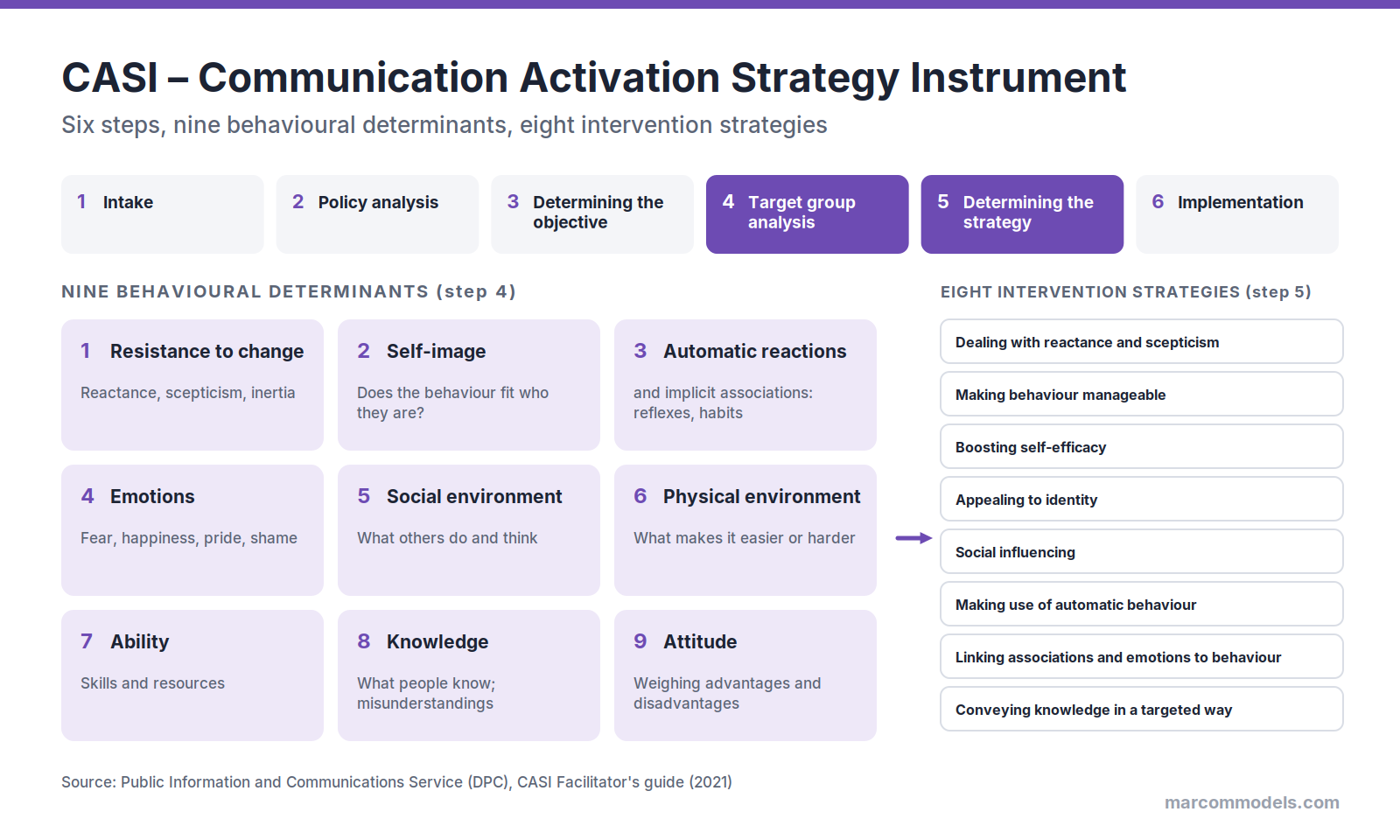
Six steps. CASI is a structured process, usually carried out in sessions with communication and policy advisers, stakeholders and – where possible – people from the target group:
- Intake – determining the intended result of the process and how it will be configured.
- Policy analysis – determining the behavioural issue based on the policy objective, the policy instruments and the stakeholders involved, and deciding whether communication plays a central or supportive role.
- Determining the objective – formulating a specific behavioural objective: who should display which desired behaviour, where and when, instead of the current behaviour.
- Target group analysis – creating personas and identifying the three most important behavioural determinants for each target group.
- Determining the strategy – choosing up to three intervention strategies that match these determinants and developing creative ideas using behavioural change techniques.
- Implementation – developing, testing and evaluating the communication interventions.
Nine behavioural determinants. CASI distinguishes nine factors that determine behaviour and on which communication can focus:
- Resistance to change – in three forms: reactance (feeling that freedom of choice is restricted), scepticism (doubting the benefits or distrusting the messenger) and inertia (passivity).
- Self-image – people have a strong need for a positive self-image; behaviour that fits it is more likely.
- Automatic reactions and implicit associations – reflexes, habits and unconscious associations.
- Emotions – such as fear, happiness, pride or shame.
- Social environment – what other people do and think.
- Physical environment – how the environment makes behaviour easier or harder.
- Ability – whether people have the skills and resources to display the behaviour.
- Knowledge – what people know and which misunderstandings exist.
- Attitude – how people weigh the advantages and disadvantages of the behaviour.
The guide advises giving priority to automatic reactions, emotions and the social environment where they are relevant, because unconscious, emotional and social processes generally have a major impact on behaviour.
Eight intervention strategies. Each strategy contains several behavioural change techniques, described on the intervention cards in the facilitator’s guide:
- Dealing with reactance and scepticism
- Making behaviour manageable
- Boosting self-efficacy
- Appealing to identity
- Social influencing
- Making use of automatic behaviour
- Linking associations and emotions to behaviour
- Conveying knowledge in a targeted way
Note that the Dutch version of CASI was updated in 2024; the English guide is based on the previous version.
Applications of CASI
CASI is used for both small-scale interventions, such as a letter to students receiving childcare allowance, and large cross-media campaigns, for example for motorists. Examples in the guide include healthy eating in military canteens, travellers preparing for risks abroad and encouraging victims of sexual violence to seek help. Organisations also use the method for internal change communication.
The guide ends with ten practical tips, such as keeping messages simple, showing the desired rather than the undesired behaviour, giving concrete instructions, communicating where the behaviour happens and repeating messages over a long period.
CASI connects to several theories on this site. Resistance to change relates to reactance theory; social environment and social influencing reflect normative and informational social influence and Cialdini’s principles of persuasion; and self-image relates to self-perception theory. CASI is comparable to intervention mapping, but is more compact and specifically aimed at communication.
Criticism
CASI is a practical method developed by a government agency rather than a scientific theory. Its determinants and strategies are drawn from behavioural science, but the instrument as a whole has received little independent academic evaluation.
The method focuses on the behaviour of individuals, while many societal problems also require structural measures such as regulation, pricing or facilities. The guide itself acknowledges this: communication can have a central or only a supportive role, and changing habitual behaviour through communication alone is difficult. Finally, the full process takes considerable time, and results depend heavily on the quality of the target group research – personas based on assumptions can lead to stereotyping.
Misuse and Flaws Compared to Similar Models
- Defaulting to knowledge. Choosing an information campaign without analysing the other determinants ignores what often matters more, such as habits, emotions and the social environment.
- Expecting communication to do everything. If behaviour is mainly limited by costs, rules or facilities, communication will have little effect.
- Personas based on clichés. Personas should be based on research, not on assumptions about the target group.
- Showing the undesired behaviour. Messages that show how many people behave badly can make that behaviour seem normal.
Conclusion
CASI helps communication professionals move beyond the classic knowledge–attitude–behaviour approach. With six steps, nine behavioural determinants and eight intervention strategies, it translates behavioural science into a structured and practical process for developing communication interventions. Its central lesson is that effective behavioural change communication starts with understanding what really drives the behaviour of the target group.
References
Kahneman, D. (2011). Thinking, fast and slow. Farrar, Straus and Giroux.
Michie, S., van Stralen, M. M., & West, R. (2011). The behaviour change wheel: A new method for characterising and designing behaviour change interventions. Implementation Science, 6, 42.
Public Information and Communications Service (DPC). (2021). CASI – Communication Activation Strategy Instrument: Facilitator’s guide. Dutch Ministry of General Affairs. https://www.communicatierijk.nl/documenten/publicaties/2021/12/09/casi-in-english