
Introduction
When an organisation speaks to journalists, stakeholders or the public, consistency is essential. Different spokespersons, channels and moments should tell the same story. The message house is a widely used practical tool for achieving this. It structures an organisation’s messages into a core message, a limited number of key messages and supporting evidence, in the shape of a simple house.
The message house is used in media relations, spokesperson training, crisis communication and campaign planning. Unlike most models on this site, it is a practitioner tool rather than a theory with one identifiable author. This article explains its structure, how to use it and its limitations.
Overview of the Message House
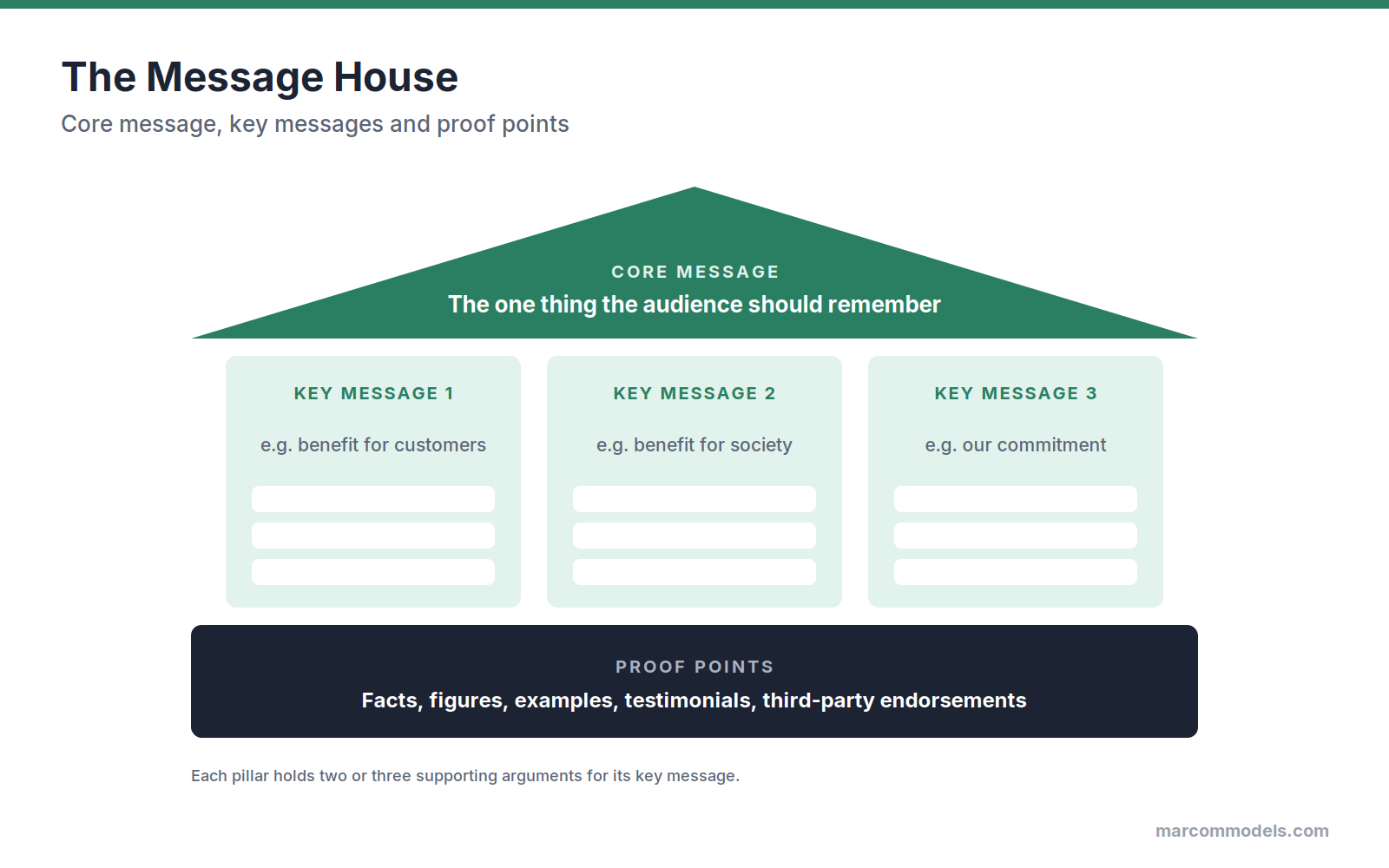
A message house consists of three levels:
- The roof: the core message. One short sentence that summarises what the organisation wants the audience to remember. It is the answer to the question: if people remember only one thing, what should it be?
- The pillars: key messages. Usually three key messages that support the core message. Each pillar addresses a different aspect, for example a benefit for customers, a benefit for society and the organisation’s commitment. Three is a practical number: easy to remember and enough to build an argument.
- The foundation: proof points. Facts, figures, examples, testimonials and third-party endorsements that make each key message credible. Without proof points, key messages remain claims.
Some versions add a base with the organisation’s values or positioning, or a separate list of anticipated difficult questions with prepared answers.
Connection with theory. The message house is a practical application of several concepts. The core message and key messages are a form of framing: they emphasise certain aspects of a topic and give it a particular interpretation. Proof points strengthen the credibility of the source and the logic of the argument – the ethos and logos of Aristotle’s modes of persuasion. In corporate communication, the message house helps to ensure that all communication expresses the same corporate story (Cornelissen, 2020).
Applications of the Message House
The message house is used in several situations:
- Media relations – preparing press releases, press conferences and interviews, so that spokespersons return to the key messages regardless of the questions asked.
- Spokesperson training – spokespersons practise answering questions and “bridging” back to a key message.
- Crisis communication – a message house provides a quick, consistent framework for the first statements in a crisis (see SCCT).
- Campaigns and change communication – the house ensures that different channels and messengers tell a coherent story.
A message house is usually created per topic or occasion, and tested beforehand with colleagues or a sample of the target group: is the core message understandable, credible and relevant?
Criticism
Because the message house is a practitioner tool, there is little empirical research into its effectiveness. Its value depends entirely on the quality of the content: a well-structured house with vague or unsubstantiated messages does not persuade anyone.
The tool is also sender-oriented. It focuses on what the organisation wants to say, not on what the audience wants to know. When spokespersons repeat key messages too rigidly, they may come across as evasive or scripted, which damages credibility – especially in interviews where journalists ask critical questions.
Misuse and Flaws Compared to Similar Tools
- Repeating messages instead of answering questions. Bridging back to key messages is useful, but ignoring the question entirely makes a spokesperson seem untrustworthy.
- Too many key messages. A house with seven pillars is no longer a house. Limit the number of key messages so that the audience can remember them.
- Claims without proof points. Key messages without facts or examples are empty promises. The foundation is what makes the house stand.
- Messages that do not match behaviour. No message house can compensate for a gap between what an organisation says and what it does.
Conclusion
The message house is a simple and effective tool for structuring communication around one core message, a few key messages and solid proof points. It helps organisations communicate consistently across spokespersons and channels, especially in media relations and crisis communication. Its strength depends on clear, substantiated and audience-relevant content, and on spokespersons who use it flexibly rather than as a script.
References
Cornelissen, J. (2020). Corporate communication: A guide to theory and practice (6th ed.). Sage.
Entman, R. M. (1993). Framing: Toward clarification of a fractured paradigm. Journal of Communication, 43(4), 51–58.