
Introduction
SWOT analysis is one of the best-known tools in strategic management, marketing and communication. It summarises the internal strengths and weaknesses of an organisation and the external opportunities and threats in its environment. The analysis is simple enough to use in almost any situation – from a multinational to a small charity or a student preparing for an internship.
This article explains the origins of the model, how to carry out a SWOT analysis, how to turn it into strategic options with the confrontation matrix (TOWS), and why the model is also criticised.
Overview of SWOT Analysis
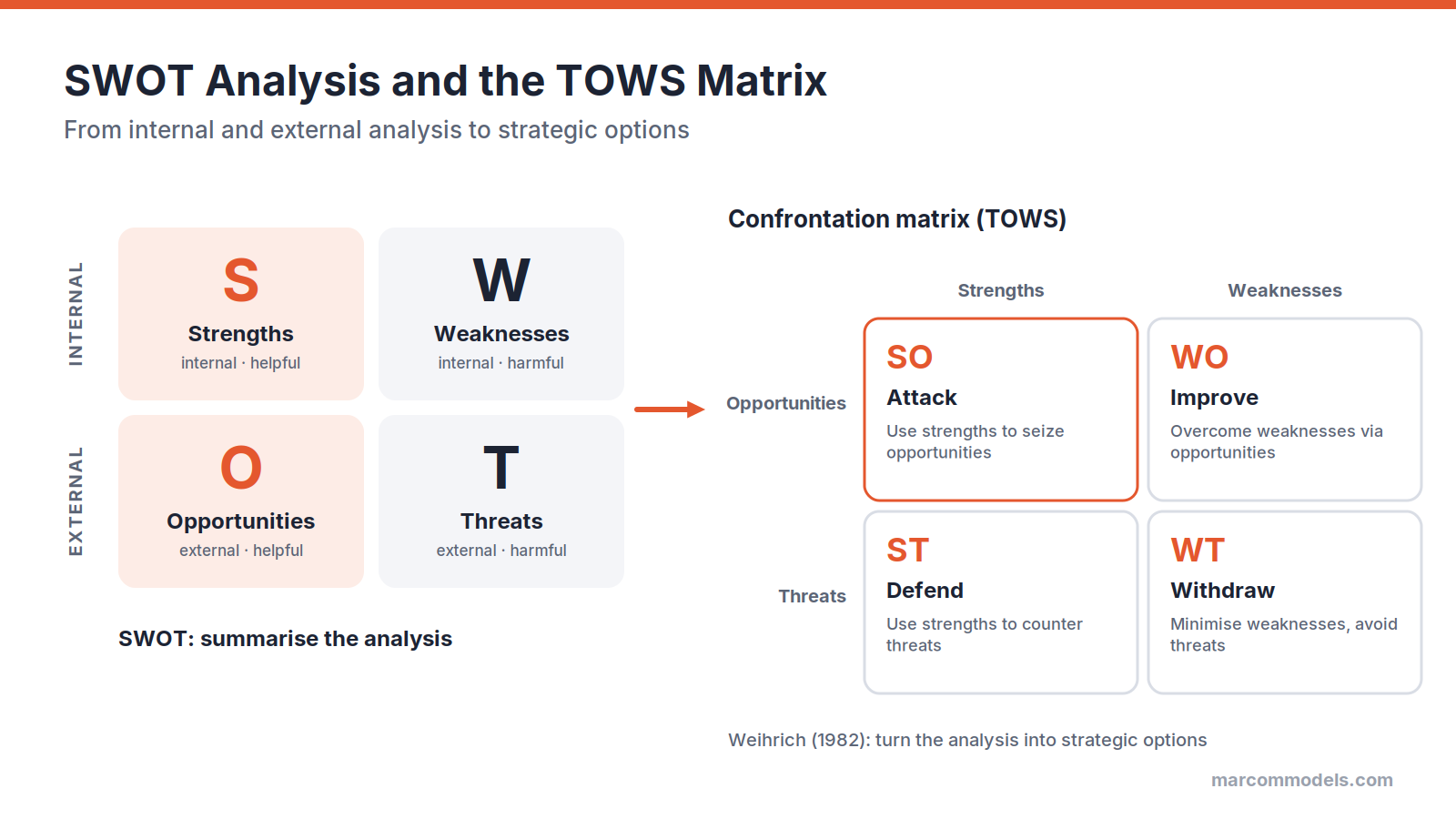
Four elements. A SWOT analysis consists of two internal and two external elements:
- Strengths – internal characteristics that give the organisation an advantage, such as a strong brand, expertise or a loyal customer base.
- Weaknesses – internal characteristics that put the organisation at a disadvantage, such as limited budgets, outdated systems or low brand awareness.
- Opportunities – external developments the organisation can benefit from, for example from a DESTEP analysis or market analysis.
- Threats – external developments that may harm the organisation, such as new competitors or stricter legislation.
Strengths and weaknesses are relative: they only count if they matter to customers and differ from competitors. Opportunities and threats are developments in the environment, not options the organisation has.
Origins. SWOT is often attributed to Albert Humphrey and a study at the Stanford Research Institute in the 1960s. Historical research by Puyt, Lie and Wilderom (2023), however, traces the model to the business policy course at Harvard Business School, where the matching of internal capabilities and external opportunities was central (Learned et al., 1965). The attribution to Humphrey turns out to be poorly supported.
The confrontation matrix (TOWS). A SWOT list alone does not lead to decisions. Weihrich (1982) therefore proposed the TOWS matrix, known in Dutch as the confrontatiematrix. It combines the internal and external factors into four types of strategic options:
- SO strategies – use strengths to seize opportunities (attack).
- WO strategies – overcome weaknesses by taking advantage of opportunities (improve).
- ST strategies – use strengths to counter threats (defend).
- WT strategies – minimise weaknesses and avoid threats (withdraw or reduce risk).
In practice, the combinations are often scored to determine which strategic issues are most important.
Applications of SWOT Analysis
SWOT analysis is used in marketing and communication plans, business plans, organisational strategy and project evaluations. It is the link between the analysis phase (internal analysis, market environment, DESTEP, Porter’s Five Forces) and the strategy phase, in which objectives and choices are formulated.
A personal SWOT is also widely used in education and career development, for example by students preparing for an internship or job applications. They map their own strengths and weaknesses against opportunities and threats in the labour market.
Criticism
Hill and Westbrook (1997) studied the use of SWOT in practice and concluded that the analyses were often long, general and unprioritised lists, and that the results were rarely used in subsequent strategy. They even called for a “product recall” of the model.
Other criticisms concern the subjectivity of the analysis: what one person calls a strength, another may see as a weakness. The categories are not always clearly separated; a development can be both an opportunity and a threat. In addition, a SWOT is a snapshot and can quickly become outdated in a dynamic environment.
Misuse and Flaws Compared to Similar Models
- Confusing opportunities with strategies. “Launching a TikTok channel” is not an opportunity but an option. The opportunity is the development behind it, for example a shift in media use among the target group.
- Listing without prioritising. A SWOT with twenty points per quadrant does not help decision-making. Limit it to the most relevant factors and substantiate them with research.
- Skipping the confrontation. Without the TOWS step, the SWOT remains a summary instead of a basis for choices.
- Using internal wishes as strengths. Strengths should be demonstrable and relevant to customers, not what the organisation would like to be good at.
Conclusion
SWOT analysis remains a valuable tool for summarising the strategic position of an organisation, provided it is based on thorough internal and external analysis and followed by the confrontation matrix. Used in that way, it forms the bridge between analysis and strategy. Used as a loose list, it offers little more than a false sense of completeness.
References
Hill, T., & Westbrook, R. (1997). SWOT analysis: It’s time for a product recall. Long Range Planning, 30(1), 46–52.
Learned, E. P., Christensen, C. R., Andrews, K. R., & Guth, W. D. (1965). Business policy: Text and cases. Irwin.
Puyt, R. W., Lie, F. B., & Wilderom, C. P. M. (2023). The origins of SWOT analysis. Long Range Planning, 56(3), 102304.
Weihrich, H. (1982). The TOWS matrix: A tool for situational analysis. Long Range Planning, 15(2), 54–66.