
Introduction
No organisation can be everything to everyone. Customers differ in needs, preferences and behaviour, and a product that appeals to one group may leave another cold. The STP model – segmentation, targeting and positioning – describes the process by which organisations divide a market into groups, choose which groups to serve and determine how they want to be perceived by those groups.
STP is a core concept in marketing textbooks such as Kotler and Armstrong’s Principles of Marketing and Verhage’s Marketing Fundamentals. It forms the link between market analysis and the marketing mix: only once the target group and positioning are clear can decisions about product, price, place and promotion be made (see the 4 P’s of marketing).
Overview of the STP Model
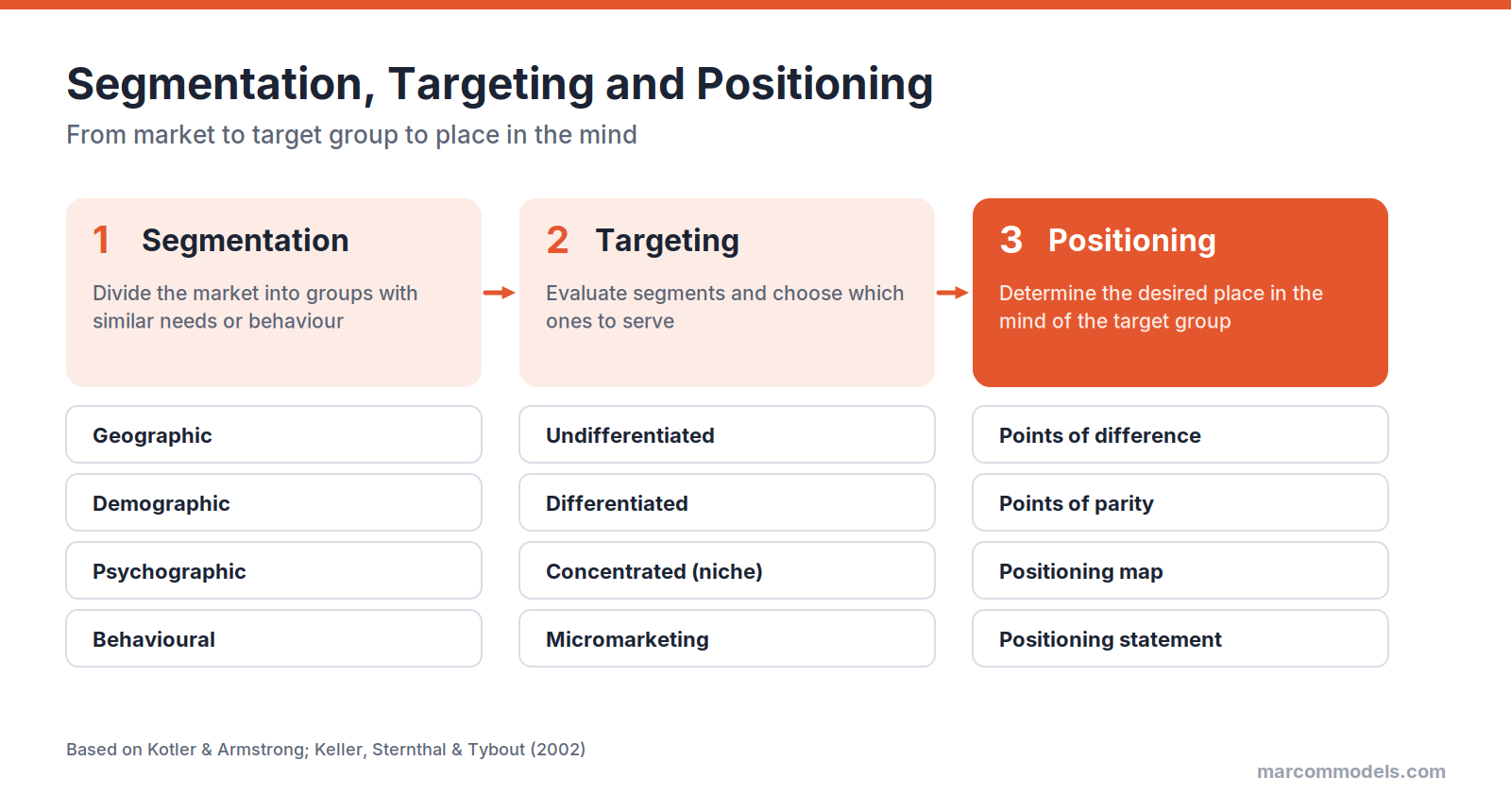
1. Segmentation. The market is divided into groups of buyers with similar needs or behaviour. Smith (1956) introduced market segmentation as an alternative to treating the market as one homogeneous whole. Common segmentation bases in consumer markets are:
- Geographic – country, region, urban or rural.
- Demographic – age, gender, income, education, household composition.
- Psychographic – lifestyle, values, personality.
- Behavioural – usage frequency, loyalty, benefits sought, occasions.
In business markets, organisations are segmented by, for example, industry, company size and buying process. To be useful, segments should be measurable, substantial (large and profitable enough), accessible, differentiable (responding differently to marketing) and actionable.
2. Targeting. The organisation evaluates the attractiveness of each segment – based on size and growth, competition and fit with its own objectives and resources – and chooses one or more target segments. Common targeting strategies are:
- Undifferentiated marketing – one offer for the whole market.
- Differentiated marketing – a separate offer for several segments.
- Concentrated (niche) marketing – focus on one or a few small segments.
- Micromarketing – tailoring the offer to local markets or individual customers.
3. Positioning. Finally, the organisation determines the place it wants to occupy in the minds of the target group relative to competitors (Ries & Trout, 1981). A positioning is built on points of difference – associations that distinguish the brand – and points of parity – associations the brand shares with competitors and needs to be considered a credible option (Keller, Sternthal & Tybout, 2002). A positioning map (perceptual map) visualises how customers perceive brands on two relevant dimensions, such as price and quality, and helps to identify gaps in the market. The positioning is usually summarised in a positioning statement.
Applications of the STP Model
STP is used in marketing plans, brand strategy and communication strategy. In marketing communication, segmentation and targeting determine to whom a campaign is aimed, while positioning determines the core message. Target groups are often translated into personas to make them concrete for creative teams.
In digital marketing, data-driven segmentation and targeting make it possible to reach segments very precisely, for example through behavioural targeting on social media. At the same time, positioning remains essential to build a consistent brand across all touchpoints of the customer journey. Positioning is also closely linked to brand equity (see the customer-based brand equity model).
Criticism
Research by the Ehrenberg-Bass Institute questions the effectiveness of narrow targeting. Sharp (2010) argues that competing brands largely sell to similar customers and that growth comes mainly from reaching many light buyers of the category, rather than from focusing on a narrowly defined segment. In this view, broad reach and mental availability are more important than precise segmentation.
Segmentation can also rely too heavily on demographic variables that say little about actual needs or behaviour. Segments are simplifications: individual customers do not always behave according to their segment, and segments change over time. Finally, highly data-driven targeting raises questions about privacy and ethics.
Misuse and Flaws Compared to Similar Models
- Choosing a target group that is too narrow. Focusing on a small segment can limit growth unnecessarily. The target group for communication can be broader than the core segment.
- Segmenting only on demographics. “Women aged 25–35” says little about needs. Combine demographic variables with needs, behaviour or motives.
- Positioning without differentiation. A positioning that claims what every competitor claims – “quality at a fair price” – does not create a distinct place in the mind.
- Skipping steps. Choosing a positioning before analysing segments leads to positions that do not fit any target group.
Conclusion
The STP model describes the essential strategic choices behind every marketing and communication plan: which market segments exist, which ones to serve and how to be perceived. Although the effectiveness of narrow targeting is debated, the model remains the basis for connecting market insights to the marketing mix and brand strategy.
References
Dibb, S. (1998). Market segmentation: Strategies for success. Marketing Intelligence & Planning, 16(7), 394–406.
Keller, K. L., Sternthal, B., & Tybout, A. (2002). Three questions you need to ask about your brand. Harvard Business Review, 80(9), 80–86.
Ries, A., & Trout, J. (1981). Positioning: The battle for your mind. McGraw-Hill.
Sharp, B. (2010). How brands grow: What marketers don’t know. Oxford University Press.
Smith, W. R. (1956). Product differentiation and market segmentation as alternative marketing strategies. Journal of Marketing, 21(1), 3–8.
Verhage, B., & Visser, M. (2023). Marketing fundamentals: An international perspective (4th ed.). Noordhoff.