
Introduction
The customer journey describes the process a customer goes through when becoming aware of, considering, buying, using and possibly recommending a product or service. The concept builds on the classic buying decision process found in marketing textbooks such as Verhage’s Marketing Fundamentals, but shifts the focus from a series of internal decisions to the full experience a customer has with a brand across many channels and moments.
Because customers today move freely between online and offline channels, the customer journey has become one of the central concepts in marketing communications. This article explains the buying decision process, the customer journey and touchpoints, and discusses applications, criticism and common mistakes.
Overview of the Customer Journey
The buying decision process. The traditional model describes five stages: problem recognition, information search, evaluation of alternatives, the purchase decision and post-purchase behaviour. How extensively a consumer goes through these stages depends on involvement. For expensive or risky purchases consumers engage in extensive problem solving; for routine purchases such as groceries several stages are shortened or skipped.
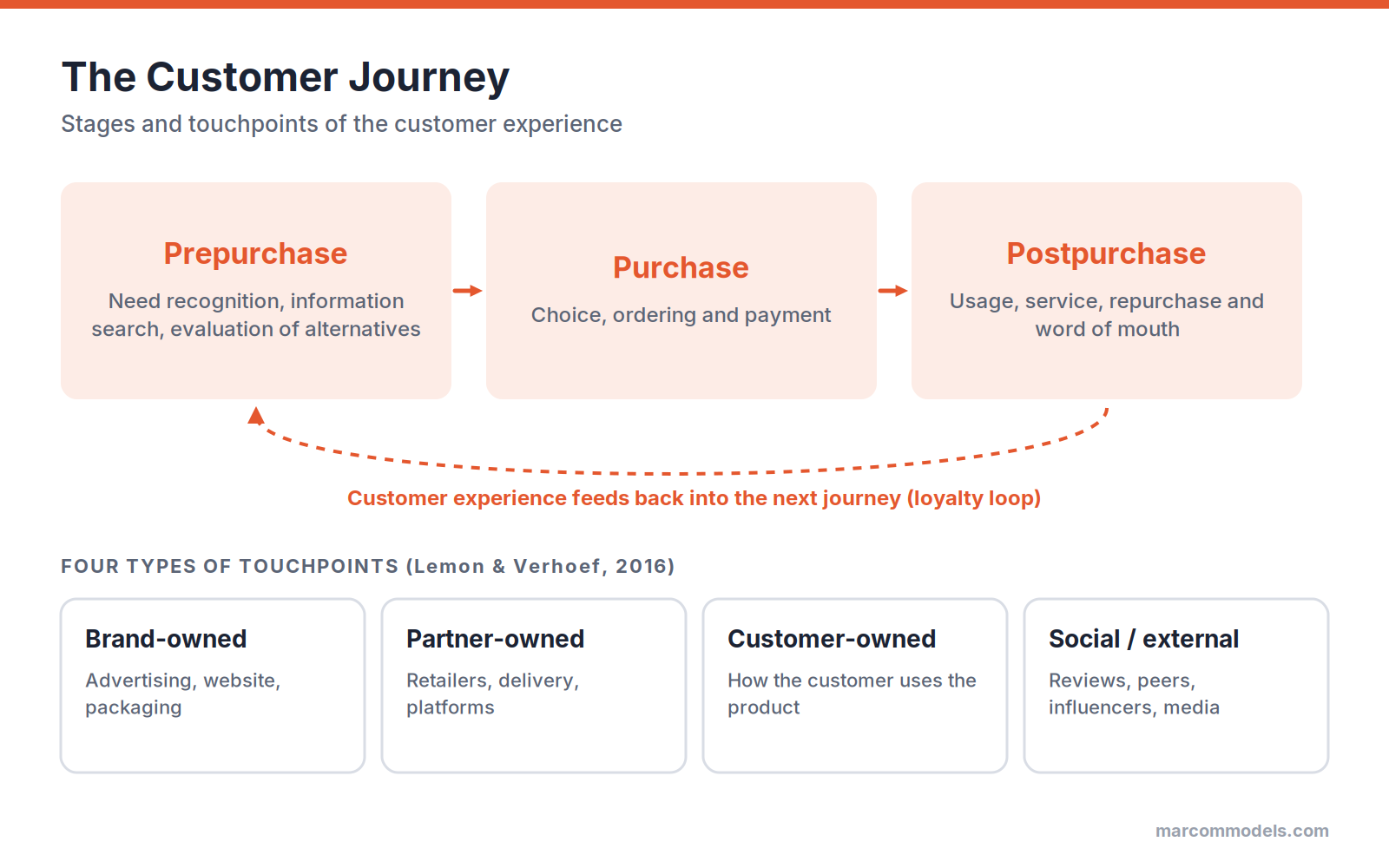
From process to journey. Lemon and Verhoef (2016) define the customer journey as the process a customer goes through across all stages and touchpoints that make up the customer experience. They distinguish three stages:
- Prepurchase – everything from need recognition to considering options.
- Purchase – choice, ordering and payment.
- Postpurchase – usage, consumption, service, repurchase and word of mouth.
Touchpoints. A touchpoint is every moment at which a customer comes into contact with a brand. Lemon and Verhoef distinguish four categories:
- Brand-owned touchpoints – designed and controlled by the company, such as advertising, the website and packaging.
- Partner-owned touchpoints – controlled together with partners, such as retailers or delivery services.
- Customer-owned touchpoints – actions of the customer that the company does not control, such as how the product is used.
- Social/external touchpoints – other customers, reviews, influencers and media.
This division connects to the distinction between paid, owned, earned and shared media (see the PESO model).
A circular journey. Court et al. (2009) proposed the consumer decision journey, in which consumers start with an initial consideration set, add and remove brands during active evaluation, buy at the moment of purchase and then enter a post-purchase experience. A positive experience can lead to a loyalty loop, in which the customer skips the evaluation stage on the next purchase.
Customer journey mapping. In practice, journeys are visualised in a customer journey map, which shows per stage the customer’s goals, touchpoints, thoughts and feelings, pain points and “moments of truth” – moments that are decisive for the customer’s evaluation of the brand.
Applications of the Customer Journey
The customer journey is used to plan marketing communications per stage: which message, medium and touchpoint fit a customer who is still orienting, compared with a customer who has just bought the product? It also helps organisations identify pain points in the customer experience, prioritise touchpoints with the greatest impact and align departments such as marketing, sales and customer service around one shared view of the customer.
In digital marketing, the journey is the basis for content strategy, marketing automation and attribution models, which try to determine which touchpoints contributed to a conversion. Edelman and Singer (2015) argue that companies can gain a competitive advantage by actively designing and optimising journeys instead of only reacting to them.
Criticism
Journey models suggest a logical sequence of stages, while real customer behaviour is often chaotic, impulsive and non-linear. Customers skip stages, return to earlier ones or make decisions largely unconsciously.
Moreover, many journey maps are based on assumptions within the organisation rather than research among customers. The resulting map then reflects the company’s view of the customer rather than the customer’s actual experience.
Finally, a large part of the journey takes place at customer-owned and social touchpoints that the company does not control. Measuring the journey across channels is also difficult, especially with increasing privacy regulation.
Misuse and Flaws Compared to Similar Models
- Confusing the journey with the funnel. Funnel models such as AIDA describe the steps an organisation wants a customer to take. The customer journey takes the customer’s perspective. Treating a journey map as a sales funnel misses its essence.
- Mapping without research. A journey map drawn in a workshop without interviews, observations or data is a hypothesis, not an insight.
- One journey for everyone. Different segments and personas follow different journeys. One generic map hides these differences.
- Mapping without acting. The map is a means, not an end. Its value lies in the improvements it leads to.
Conclusion
The customer journey extends the classic buying decision process into a customer-centred view of all interactions between a customer and a brand. By distinguishing stages and types of touchpoints, it helps marketers plan communication and improve the customer experience. Its value depends on research-based mapping and on the recognition that real customers rarely follow a neat, linear path.
References
Court, D., Elzinga, D., Mulder, S., & Vetvik, O. J. (2009). The consumer decision journey. McKinsey Quarterly, (3), 96–107.
De Pelsmacker, P., Geuens, M., & Van den Bergh, J. (2021). Marketing communications: A European perspective (7th ed.). Pearson.
Edelman, D. C., & Singer, M. (2015). Competing on customer journeys. Harvard Business Review, 93(11), 88–100.
Lemon, K. N., & Verhoef, P. C. (2016). Understanding customer experience throughout the customer journey. Journal of Marketing, 80(6), 69–96.
Verhage, B., & Visser, M. (2023). Marketing fundamentals: An international perspective (4th ed.). Noordhoff.