
Introduction
Do media messages influence people directly? In the 1940s, many researchers assumed they did: mass media were thought to have powerful, direct effects on a passive audience. A study of the 1940 US presidential election challenged that idea. Lazarsfeld, Berelson and Gaudet (1944) found that voters were influenced less by newspapers and radio than by conversations with people around them.
From this study emerged the two-step flow theory: media messages first reach opinion leaders, who then pass them on to others. The later multi-step flow model extended this idea into networks of influence. Both are part of the media theory discussed in corporate communication and mass communication courses, and they help explain the rise of influencer marketing.
Overview of the Two-Step and Multi-Step Flow
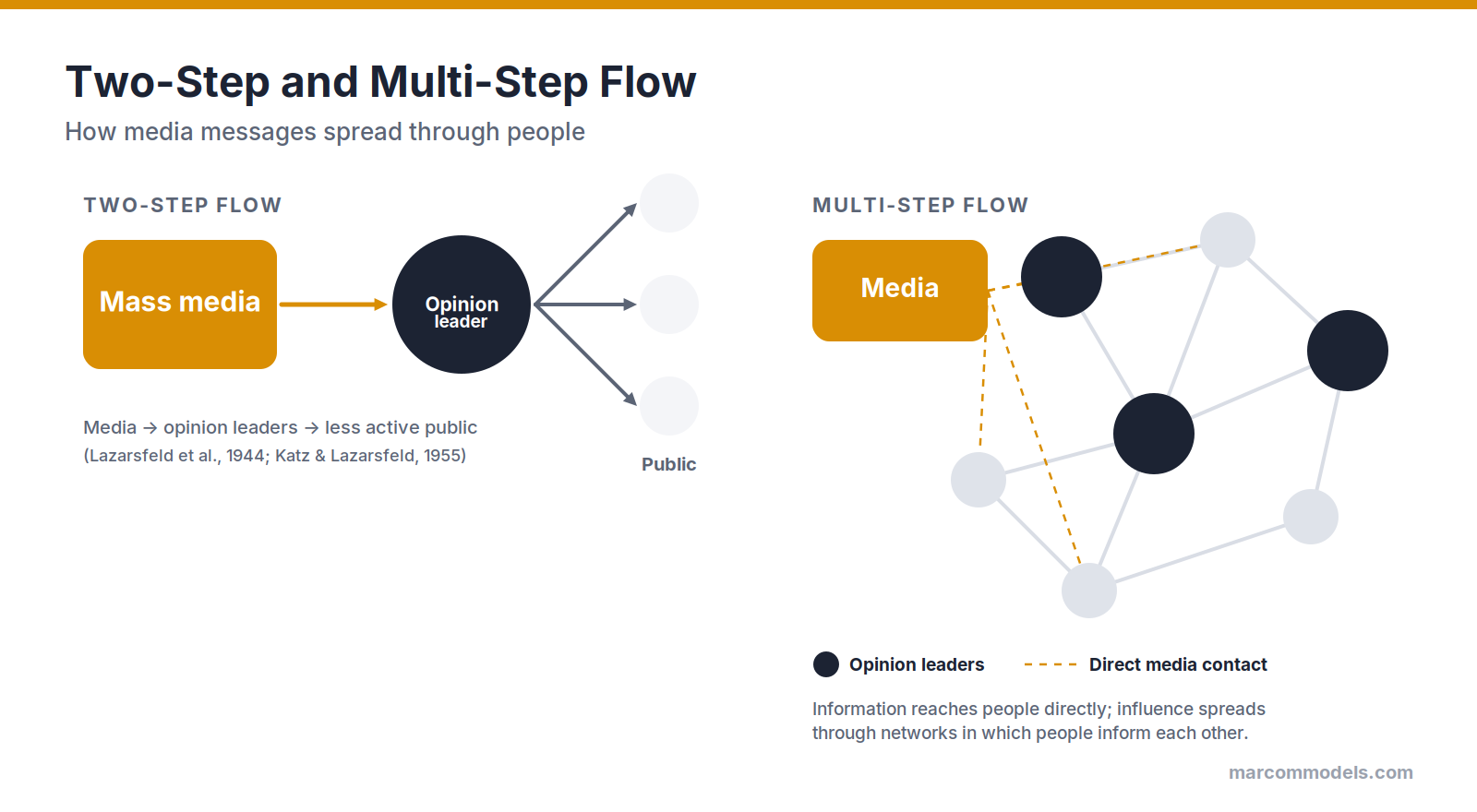
Two-step flow. In The People’s Choice, Lazarsfeld et al. (1944) concluded that ideas often flow from radio and print to opinion leaders and from them to the less active sections of the population. The theory was developed further by Katz and Lazarsfeld (1955) in Personal Influence, a study of decisions about shopping, fashion, public affairs and films.
Opinion leaders are not necessarily people with formal status. They are people who are:
- more interested in and more exposed to media on a specific topic;
- regarded by others as knowledgeable and trustworthy on that topic;
- socially well connected within their group.
Opinion leadership turned out to be topic-specific: someone may be an opinion leader on fashion but not on politics. Katz (1957) summarised the findings and emphasised that interpersonal relations act as both channels of information and sources of social pressure.
Multi-step flow. Later research showed that the two-step model was too simple. Information often reaches people directly through media, while influence – the actual change in opinion or behaviour – spreads through networks of interpersonal contacts. Opinion leaders also influence each other and seek advice from other opinion leaders. The multi-step flow model therefore describes communication as a flow through several steps and networks, in which people alternately act as receivers and senders.
Applications of the Two-Step and Multi-Step Flow
The theories are the foundation of several communication practices:
- Influencer marketing – brands work with people who have credibility and reach within a specific community.
- Word-of-mouth and ambassador programmes – loyal customers or employees are activated to share their experiences.
- Stakeholder and public affairs strategies – organisations identify key opinion leaders, such as experts, journalists or community leaders, who shape debates on issues (see the issue life cycle).
- Internal communication – managers and informal leaders act as opinion leaders in change processes.
The idea of opinion leaders is also central in Rogers’ (2003) diffusion of innovations, which describes how new ideas spread through social systems.
Criticism
The original research was carried out in the United States in the 1940s and 1950s, in a media landscape completely different from today’s. Later studies found that many people receive news directly from media rather than through opinion leaders, so the two-step flow is at best a partial description of reality.
The distinction between opinion leaders and followers is also too rigid: influence is often mutual and depends on the topic and situation. In the current media environment, Bennett and Manheim (2006) even argue for a “one-step flow”, in which highly targeted, personalised messages reach individuals directly, bypassing social groups. Algorithms on social media platforms now play a role that the original theory could not anticipate.
Misuse and Flaws Compared to Similar Theories
- Equating followers with influence. A large number of followers does not make someone an opinion leader. Credibility and relevance within a specific community matter more than reach.
- Assuming a one-way flow. Opinion leaders are not passive transmitters of brand messages. They interpret, adapt and sometimes reject messages.
- Ignoring direct media effects. The two-step flow complements rather than replaces theories of direct media influence such as agenda-setting and framing.
Conclusion
The two-step and multi-step flow theories showed that media influence is shaped by social relationships. Opinion leaders interpret and pass on media messages, and influence spreads through networks rather than directly from sender to mass audience. Although the media landscape has changed dramatically, the core insight – that people are influenced by people they trust – remains highly relevant for influencer marketing, word of mouth and stakeholder communication.
References
Bennett, W. L., & Manheim, J. B. (2006). The one-step flow of communication. The Annals of the American Academy of Political and Social Science, 608(1), 213–232.
Katz, E. (1957). The two-step flow of communication: An up-to-date report on an hypothesis. Public Opinion Quarterly, 21(1), 61–78.
Katz, E., & Lazarsfeld, P. F. (1955). Personal influence: The part played by people in the flow of mass communications. Free Press.
Lazarsfeld, P. F., Berelson, B., & Gaudet, H. (1944). The people’s choice: How the voter makes up his mind in a presidential campaign. Duell, Sloan and Pearce.
Rogers, E. M. (2003). Diffusion of innovations (5th ed.). Free Press.