
Introduction
Why do some opinions dominate public debate while others seem to disappear, even when many people privately hold them? The German political scientist Elisabeth Noelle-Neumann (1974) offered an explanation: the spiral of silence. People constantly assess which opinions are gaining or losing ground. Those who believe their opinion is in the minority are less likely to express it, for fear of social isolation. As a result, the dominant opinion appears even stronger, and the minority opinion even weaker.
The theory connects media, public opinion and social psychology, and is part of the media theory taught in communication programmes. It remains relevant for understanding debates on social media, polarisation and corporate reputation.
Overview of the Spiral of Silence
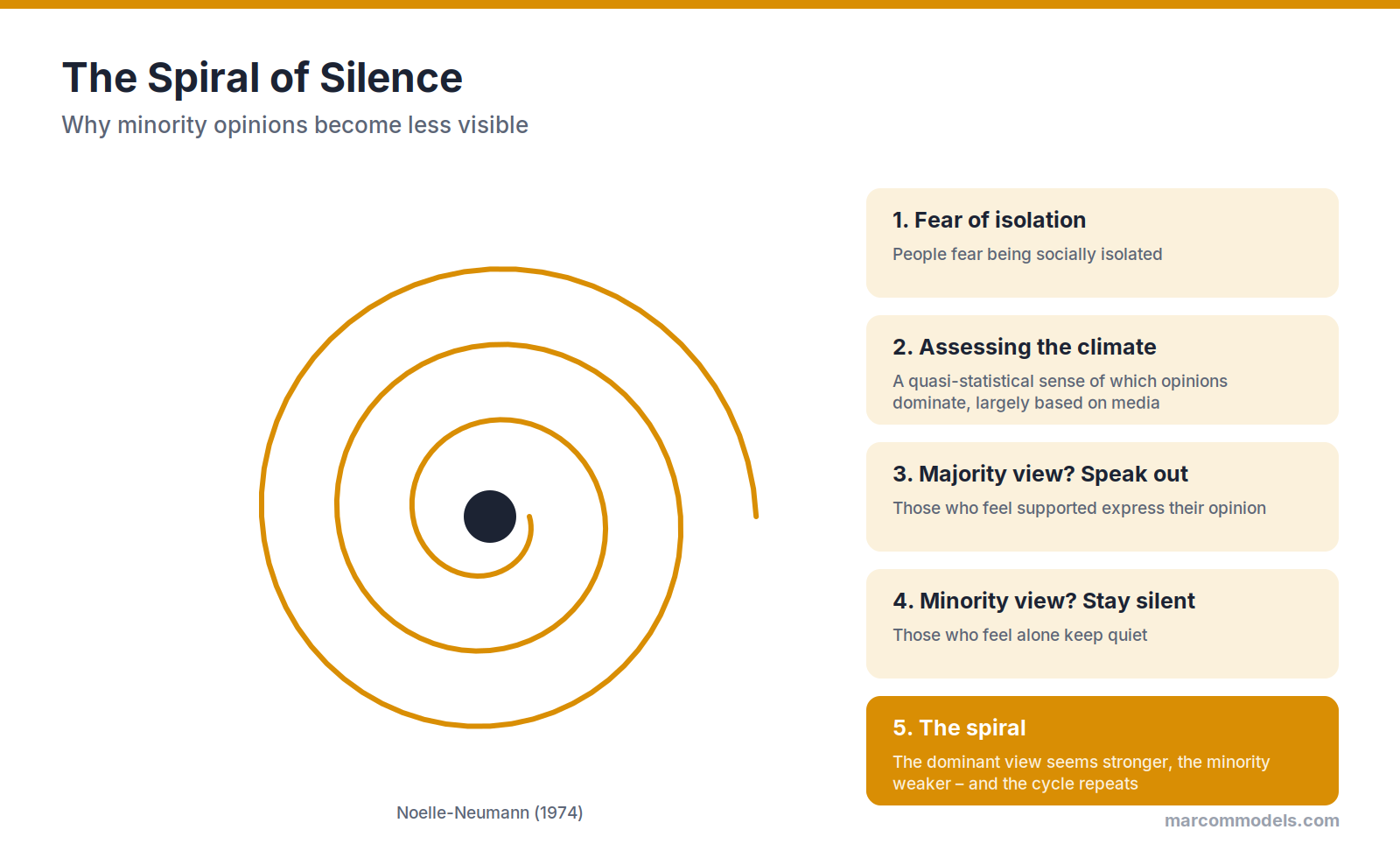
The theory rests on several assumptions (Noelle-Neumann, 1974, 1993):
- Fear of isolation. Society threatens deviating individuals with isolation, and people fear being isolated.
- Quasi-statistical sense. Individuals continuously estimate the climate of opinion: which views are popular, and which are growing or declining.
- Willingness to speak out. People who believe their opinion is shared by the majority or is gaining ground speak out more readily. Those who believe they are in the minority tend to remain silent.
- The spiral. Because one side speaks out and the other remains silent, the perceived distribution of opinion shifts further, reinforcing the process.
The role of the media. People form their image of the climate of opinion largely through the media. When media consistently present one view as dominant, they influence which opinions people consider acceptable to express. In this way, the theory links to agenda-setting and framing.
Exceptions. Noelle-Neumann distinguished a hard core: people who continue to express their opinion regardless of the social climate. Such groups can be the origin of later shifts in public opinion.
Applications of the Spiral of Silence
The theory helps communication professionals understand why public debate does not always reflect actual opinions. In issue management, it explains why an issue can seem to arise suddenly: people who were silent begin to speak once they notice that others share their views.
In corporate communication, the theory is relevant for internal communication and change processes: employees who disagree with management may remain silent in meetings, giving leaders a false picture of support. In online community management, organisations can take the theory into account by creating safe spaces for different opinions. The theory also relates to normative social influence: the pressure to conform to what others think.
On social media, research by the Pew Research Center (Hampton et al., 2014) found that people were less willing to discuss a controversial political issue on social media than in person, and more willing to speak when they believed their followers agreed with them.
Criticism
Meta-analysis shows only a small relationship between perceived support for one’s opinion and willingness to speak out (Glynn, Hayes & Shanahan, 1997). Fear of isolation varies between individuals and cultures, and other factors – such as interest in the topic, knowledge and personal involvement – also influence whether people speak out.
The theory was developed in an era of mass media. On social media, people can easily find like-minded others, which may reduce the fear of isolation within their own group while increasing polarisation between groups. The theory also pays little attention to the role of reference groups: people may care more about the opinion of their friends than about that of society as a whole.
Misuse and Flaws Compared to Similar Theories
- Treating silence as agreement. Organisations that interpret the absence of criticism as support may be surprised when opposition suddenly emerges.
- Using the theory to manipulate perceptions. Deliberately creating the impression of a majority – for example through fake accounts or bots – exploits the mechanism and is unethical.
- Assuming a universal effect. The strength of the spiral depends on culture, topic and group; it should not be assumed to apply equally to everyone.
Conclusion
The spiral of silence explains how the fear of isolation can make minority opinions invisible and dominant opinions appear stronger than they are. Although empirical support is modest and the media landscape has changed, the theory offers a valuable lens for understanding public debate, issue development and internal communication. For communication professionals, its key lesson is that silence does not necessarily mean agreement.
References
Glynn, C. J., Hayes, A. F., & Shanahan, J. (1997). Perceived support for one’s opinions and willingness to speak out: A meta-analysis of survey studies on the “spiral of silence”. Public Opinion Quarterly, 61(3), 452–463.
Hampton, K. N., Rainie, L., Lu, W., Dwyer, M., Shin, I., & Purcell, K. (2014). Social media and the “spiral of silence”. Pew Research Center.
Noelle-Neumann, E. (1974). The spiral of silence: A theory of public opinion. Journal of Communication, 24(2), 43–51.
Noelle-Neumann, E. (1993). The spiral of silence: Public opinion – our social skin (2nd ed.). University of Chicago Press.