
Introduction
Early media research focused mainly on the question of what media do to people: how do newspapers, radio and television influence opinions and behaviour? The uses and gratifications approach reverses that question and asks what people do with media. It assumes an active audience that deliberately chooses media and content to satisfy specific needs.
The approach became influential in the 1970s through the work of Katz, Blumler and Gurevitch and remains relevant today, especially for understanding why people use social media platforms. This article discusses the core assumptions of the theory, the main typologies of media needs, and its applications and limitations.
Overview of Uses and Gratifications Theory
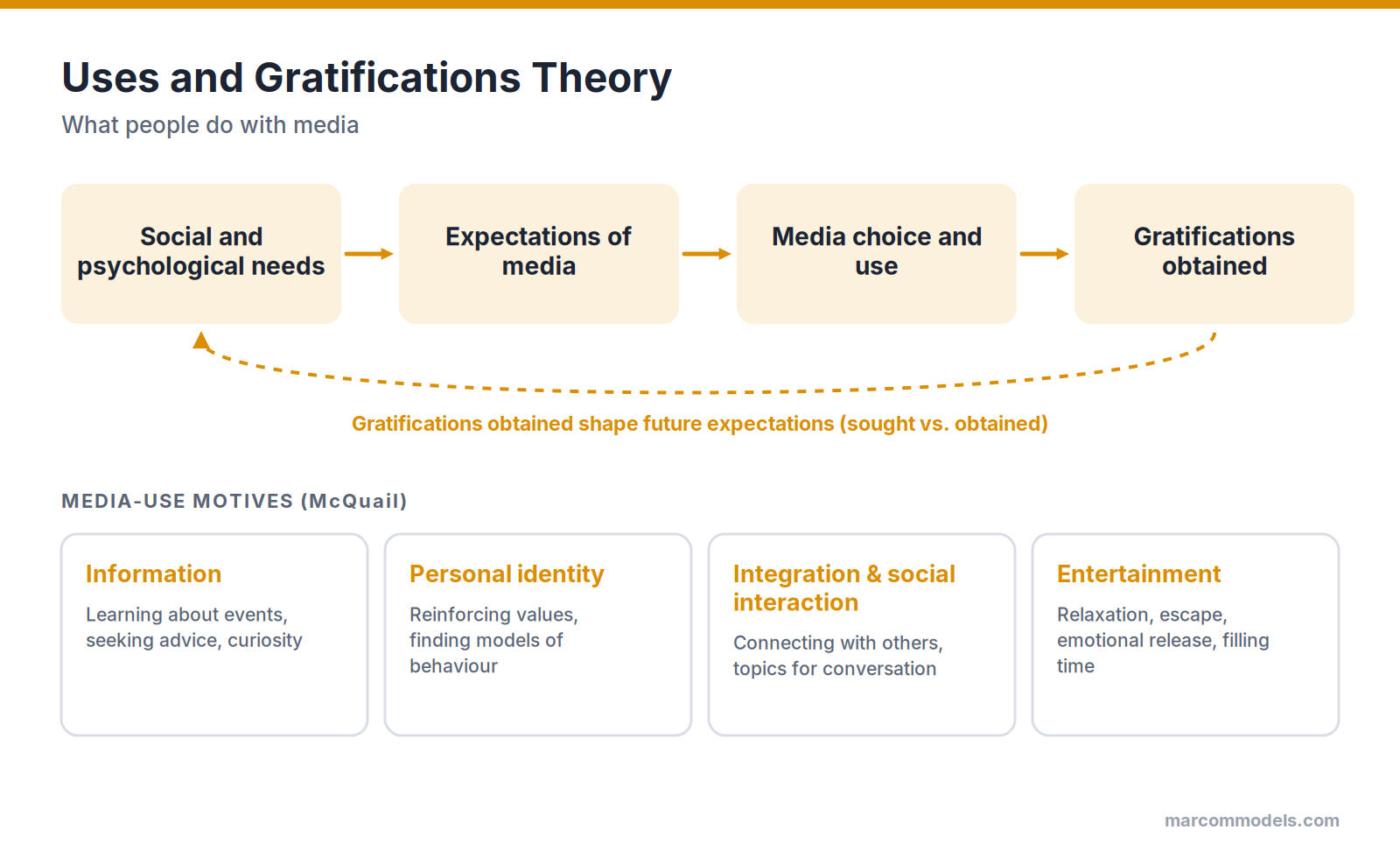
Katz, Blumler and Gurevitch (1973) formulated the core assumptions of the approach:
- The audience is active and its media use is goal-directed.
- The initiative in linking a need to a specific medium lies with the audience member, not with the medium.
- Media compete with other sources of need satisfaction, such as conversations with friends or hobbies.
- People are sufficiently aware of their own needs to report them in research.
- Researchers should not judge the cultural value of media use; the audience’s own experience is the starting point.
Typologies of media needs. McQuail (see McQuail & Deuze, 2020) distinguishes four main motives for media use:
- Information – learning about events and the environment, seeking advice, satisfying curiosity.
- Personal identity – finding reinforcement for personal values and models of behaviour.
- Integration and social interaction – gaining insight into others, having topics for conversation, feeling connected.
- Entertainment – relaxation, escape from problems, emotional release and filling time.
Gratifications sought and obtained. Palmgreen, Wenner and Rayburn (1980) distinguished between the gratifications people seek from a medium and those they actually obtain. The gap between the two helps explain why people keep using or abandon a medium.
Social media. Whiting and Williams (2013) identified ten reasons for using social media, including social interaction, information seeking, passing time, entertainment, relaxation, expressing opinions, sharing information and “surveillance” of what others are doing. Sundar and Limperos (2013) added that the technology itself – for example interactivity or the ability to personalise content – can create new gratifications.
Applications of Uses and Gratifications Theory
For communication professionals, the theory offers a lens for audience analysis. Instead of asking only which channel reaches a target group, the question becomes which need a target group satisfies on that channel. A user who scrolls through short videos to relax is receptive to different content than someone searching for product information.
The theory is used in content strategy, choosing social media platforms, developing formats that match the use situation, and in audience research through interviews and surveys. In corporate communication, it helps explain why stakeholders follow certain news sources or organisations online.
Criticism
The theory has been criticised for being too individualistic and functionalist: it places the explanation of media use with individual needs and pays little attention to social structures, habits and the power of media organisations (Ruggiero, 2000).
Methodologically, the theory relies heavily on self-reporting. People are not always aware of their motives, and much media use is habitual rather than deliberate. Concepts such as “need” and “gratification” are also defined rather vaguely, which makes the theory difficult to test.
Finally, by emphasising the active audience, the theory can underestimate media effects. Agenda-setting and framing research shows that media influence what people think about and how they interpret issues, even among active users.
Misuse and Flaws Compared to Similar Theories
- Concluding that media have no influence. An active audience does not mean that media have no effects. Uses and gratifications complements effects theories such as agenda-setting and framing; it does not replace them.
- Treating stated motives as actual behaviour. What people say about their media use in surveys often differs from their actual behaviour. Combining surveys with behavioural data gives a more reliable picture.
- Assuming the audience is rational. The theory assumes goal-directed choices, while platform algorithms and habits increasingly determine what people see.
Conclusion
Uses and gratifications theory shifts the focus from the medium to the user and explains media choice from the needs of the audience. It remains a valuable lens for audience analysis and content strategy, especially in the age of social media. Used in combination with media effects theories, it offers a more complete picture of the relationship between media and the public.
References
Katz, E., Blumler, J. G., & Gurevitch, M. (1973). Uses and gratifications research. Public Opinion Quarterly, 37(4), 509–523.
McQuail, D., & Deuze, M. (2020). McQuail’s media and mass communication theory (7th ed.). Sage.
Palmgreen, P., Wenner, L. A., & Rayburn, J. D. (1980). Relations between gratifications sought and obtained: A study of television news. Communication Research, 7(2), 161–192.
Ruggiero, T. E. (2000). Uses and gratifications theory in the 21st century. Mass Communication & Society, 3(1), 3–37.
Sundar, S. S., & Limperos, A. M. (2013). Uses and grats 2.0: New gratifications for new media. Journal of Broadcasting & Electronic Media, 57(4), 504–525.
Whiting, A., & Williams, D. (2013). Why people use social media: A uses and gratifications approach. Qualitative Market Research, 16(4), 362–369.