
Introduction
People remember stories far better than facts. That is why storytelling has become an important part of marketing and corporate communication: brands and organisations use stories to convey their values, explain change or make abstract topics tangible. But what makes a story work? One of the oldest and most widely used answers is the three-act structure.
The idea that a story has a beginning, a middle and an end goes back to Aristotle’s Poetics. Screenwriting teacher Syd Field (1979) turned it into a practical model with three acts and turning points. This article explains the three-act structure, related models and its application in brand and corporate storytelling.
Overview of the Three-Act Structure
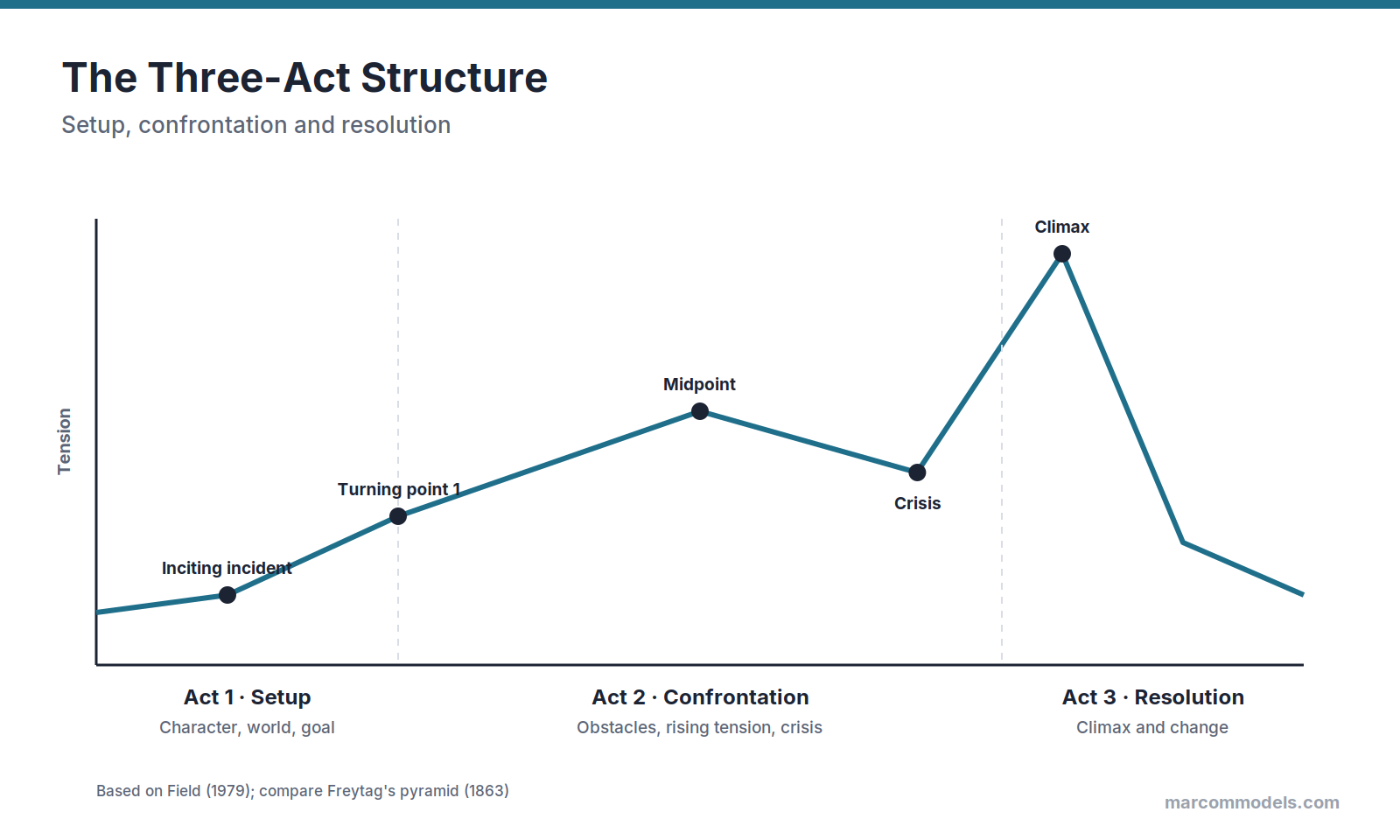
Act 1: Setup. The story introduces the main character, their world and what they want. An inciting incident disrupts the status quo, and at the end of the first act, a first turning point forces the character to take action. In film, the first act typically takes about a quarter of the story.
Act 2: Confrontation. The main character pursues their goal and encounters obstacles, opponents and setbacks. Tension rises. Around the middle, there is often a turning point that changes the character’s understanding of the situation. The second act ends with a crisis: the moment when everything seems lost. This is usually the longest act, about half of the story.
Act 3: Resolution. The character faces the final challenge in a climax and the conflict is resolved. The story ends with a new situation in which the character – and often the world around them – has changed.
Key elements. Regardless of the structure, effective stories contain a recognisable character with a goal, an obstacle or conflict, and a change or transformation. Without conflict, there is no story, only a description.
Related models. Freytag’s pyramid (1863) describes five parts of drama: exposition, rising action, climax, falling action and resolution. The hero’s journey (Campbell, 1949) describes a longer sequence of stages in which a hero leaves the familiar world, is tested and returns transformed. Both can be seen as elaborations of the same basic structure.
Applications of the Three-Act Structure
In advertising, the structure is used for commercials and online videos: in a few seconds or minutes, a character encounters a problem, struggles and finds a resolution – often with the brand as a helper rather than the hero. In corporate storytelling, it is used to tell the story of the organisation’s origins, a change process or a customer case (Denning, 2011).
Storytelling also has a persuasive function. Research on narrative transportation shows that people who are absorbed in a story are less critical of its claims and more likely to adopt the attitudes it conveys (Green & Brock, 2000). Stories help consumers make sense of brands and their own experiences (Woodside, Sood & Miller, 2008). In this sense, storytelling connects to pathos in Aristotle’s modes of persuasion and to the peripheral route of the Elaboration Likelihood Model.
Criticism
The three-act structure is a convention, not a law. Many successful stories – particularly outside Western traditions – follow different structures, and very short formats such as social media posts may not have room for three full acts.
Rigid application can lead to predictable, formulaic stories. In corporate communication, there is also a risk that storytelling becomes a tool for embellishing reality: a compelling story is no substitute for facts, and stories that are not true or do not match the organisation’s behaviour damage credibility.
Misuse and Flaws Compared to Similar Models
- Making the brand the hero. Stories are often more engaging when the customer or employee is the hero and the brand is the helper or guide.
- A story without conflict. A description of how good an organisation is, without any obstacle or change, is not a story.
- Fabricating stories. Corporate stories must be authentic. Invented or exaggerated stories undermine trust once they are discovered.
Conclusion
The three-act structure – setup, confrontation and resolution – offers a simple, proven framework for building stories that engage and persuade. For brands and organisations, it helps to turn values, changes and customer experiences into stories people remember. Used flexibly and authentically, it is one of the most valuable tools in the communication professional’s toolbox.
References
Campbell, J. (1949). The hero with a thousand faces. Pantheon Books.
Denning, S. (2011). The leader’s guide to storytelling: Mastering the art and discipline of business narrative (Rev. ed.). Jossey-Bass.
Field, S. (1979). Screenplay: The foundations of screenwriting. Dell.
Freytag, G. (1863). Die Technik des Dramas. Hirzel.
Green, M. C., & Brock, T. C. (2000). The role of transportation in the persuasiveness of public narratives. Journal of Personality and Social Psychology, 79(5), 701–721.
Woodside, A. G., Sood, S., & Miller, K. E. (2008). When consumers and brands talk: Storytelling theory and research in psychology and marketing. Psychology & Marketing, 25(2), 97–145.