
Introduction
Launching a new brand is expensive and risky. Many companies therefore use an existing, well-known brand name to introduce a new product: a brand extension. Think of a chocolate brand launching ice cream, a sports brand launching a fitness app, or a car brand introducing a cheaper model. A successful extension benefits from the awareness and associations of the parent brand; an unsuccessful one can damage it.
Brand extensions are a central topic in strategic brand management (Keller & Swaminathan, 2020) and closely related to the customer-based brand equity model. This article discusses the types of extensions, the factors that determine their success and the risks involved.
Overview of Brand Extensions
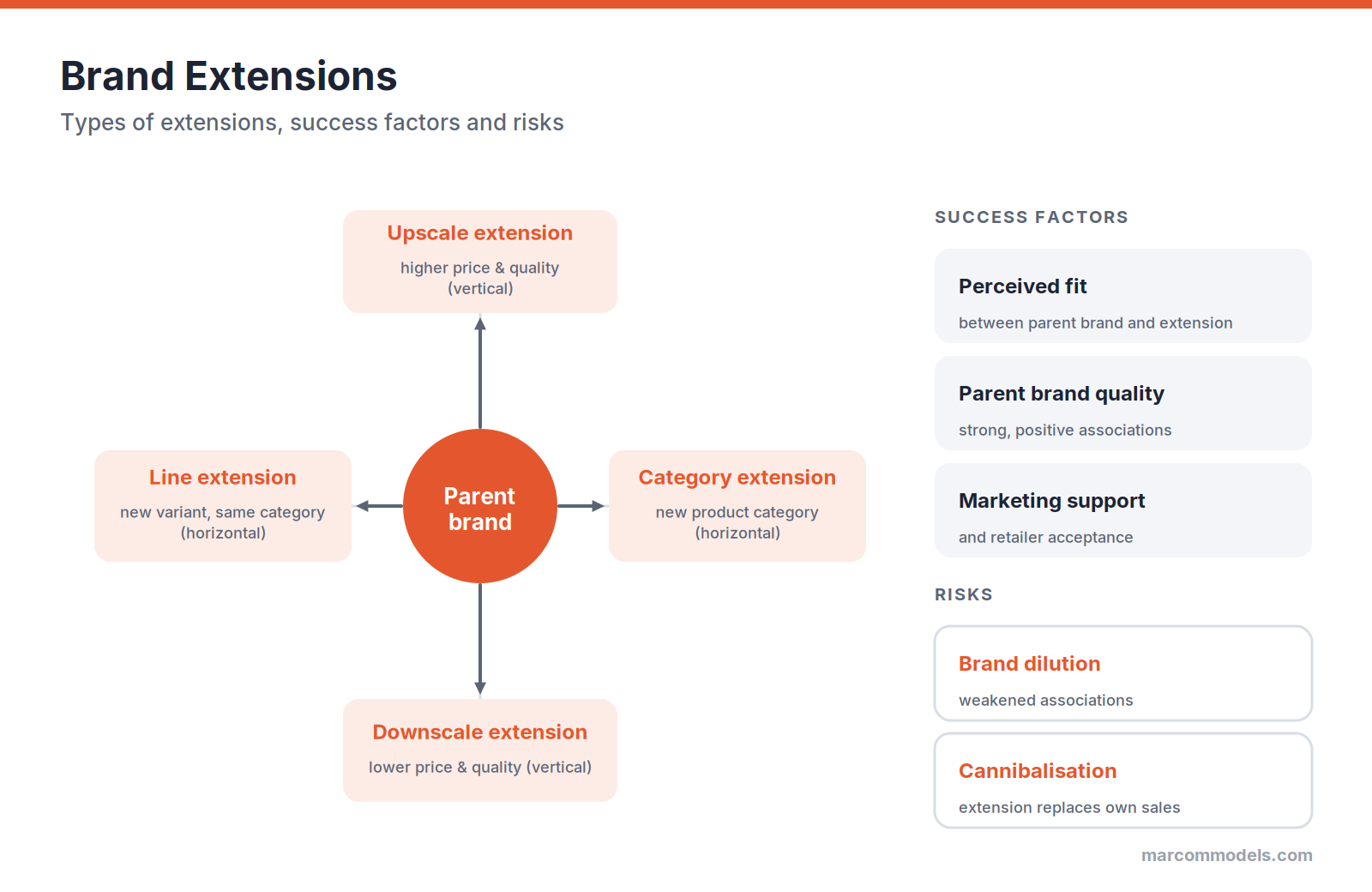
Line and category extensions. Keller distinguishes two main types:
- Line extension – the parent brand is used for a new product within the same product category, for example a new flavour, size or variant.
- Category extension – the parent brand is used to enter a different product category, for example a clothing brand launching perfume.
Vertical and horizontal extensions. A second distinction concerns the position of the extension relative to the parent brand:
- Vertical extension – a version of the brand at a higher (upscale) or lower (downscale) price and quality level, often using a sub-brand. Downscale extensions can attract new customers but risk damaging the brand’s premium image; upscale extensions are often less credible.
- Horizontal extension – an extension at the same price and quality level, into a new variant or category.
Success factors. Aaker and Keller (1990) showed that consumers evaluate an extension more positively when there is a perceived fit between the parent brand and the extension, and when the parent brand is associated with high quality. Völckner and Sattler (2006) identified fit as the most important driver of extension success, followed by marketing support, retailer acceptance and the parent brand’s conviction and experience. Fit can be based on product features, but also on brand image, target group or usage situation.
Feedback effects. Extensions also influence the parent brand. A successful extension can strengthen brand awareness and broaden brand associations. An unsuccessful or poorly fitting extension can lead to brand dilution: weakening of the associations that make the brand strong (Loken & Roedder John, 1993).
Applications of Brand Extensions
Brand extensions are used to enter new markets at lower cost, to respond to changing consumer needs, to reach new target groups and to strengthen the parent brand’s positioning. In brand strategy, extensions are part of decisions on brand architecture: when is it better to use the existing brand, a sub-brand or a completely new brand?
For marketing communication, extensions require choices about how explicitly the link with the parent brand is shown and which associations are transferred. The evaluation of an extension concept often involves consumer research into perceived fit and expected quality.
Criticism
Research on brand extensions has often relied on experiments with fictitious extensions and student samples, which may not reflect real purchase decisions. The concept of fit is also difficult to define and measure: consumers may perceive fit in ways that marketers do not anticipate.
In addition, the long-term effects of extensions on the parent brand are difficult to study. Many extensions fail quietly, and the damage to the brand only becomes visible years later. Finally, excessive extension can lead to brands that stand for everything and therefore for nothing.
Misuse and Flaws Compared to Similar Models
- Extending without fit. A strong brand name does not guarantee success in a category where the brand’s associations are irrelevant or conflicting.
- Too many line extensions. Endless variants can confuse consumers, cannibalise existing products and increase costs.
- Downscale extensions of premium brands. Cheaper versions can attract new customers but may undermine the exclusivity that made the brand valuable.
- Ignoring feedback effects. An extension is not only evaluated on its own sales, but also on its impact on the parent brand.
Conclusion
Brand extensions allow companies to use the equity of existing brands to launch new products efficiently. Their success depends largely on the perceived fit with the parent brand and the quality of that brand. At the same time, every extension affects the parent brand, positively or negatively. Brand extensions should therefore be part of a deliberate brand strategy rather than a quick way to launch new products.
References
Aaker, D. A., & Keller, K. L. (1990). Consumer evaluations of brand extensions. Journal of Marketing, 54(1), 27–41.
Keller, K. L., & Swaminathan, V. (2020). Strategic brand management: Building, measuring, and managing brand equity (5th ed.). Pearson.
Loken, B., & Roedder John, D. (1993). Diluting brand beliefs: When do brand extensions have a negative impact? Journal of Marketing, 57(3), 71–84.
Völckner, F., & Sattler, H. (2006). Drivers of brand extension success. Journal of Marketing, 70(2), 18–34.