
Introduction
Not every communication challenge calls for the same approach. Announcing new opening hours requires something different from convincing people to change their behaviour, and both require something different from involving residents in a decision about their neighbourhood. Van Ruler’s communication grid, known in the Netherlands as het Communicatiekruispunt, helps communication professionals choose a suitable communication strategy for each situation.
The model was introduced in Dutch by Betteke van Ruler in 1998 and published internationally in 2004. It is widely used in Dutch communication education and practice and also appears in the Strategic Communication Frame that Van Ruler later developed with Frank Körver.
Overview of the Communication Grid
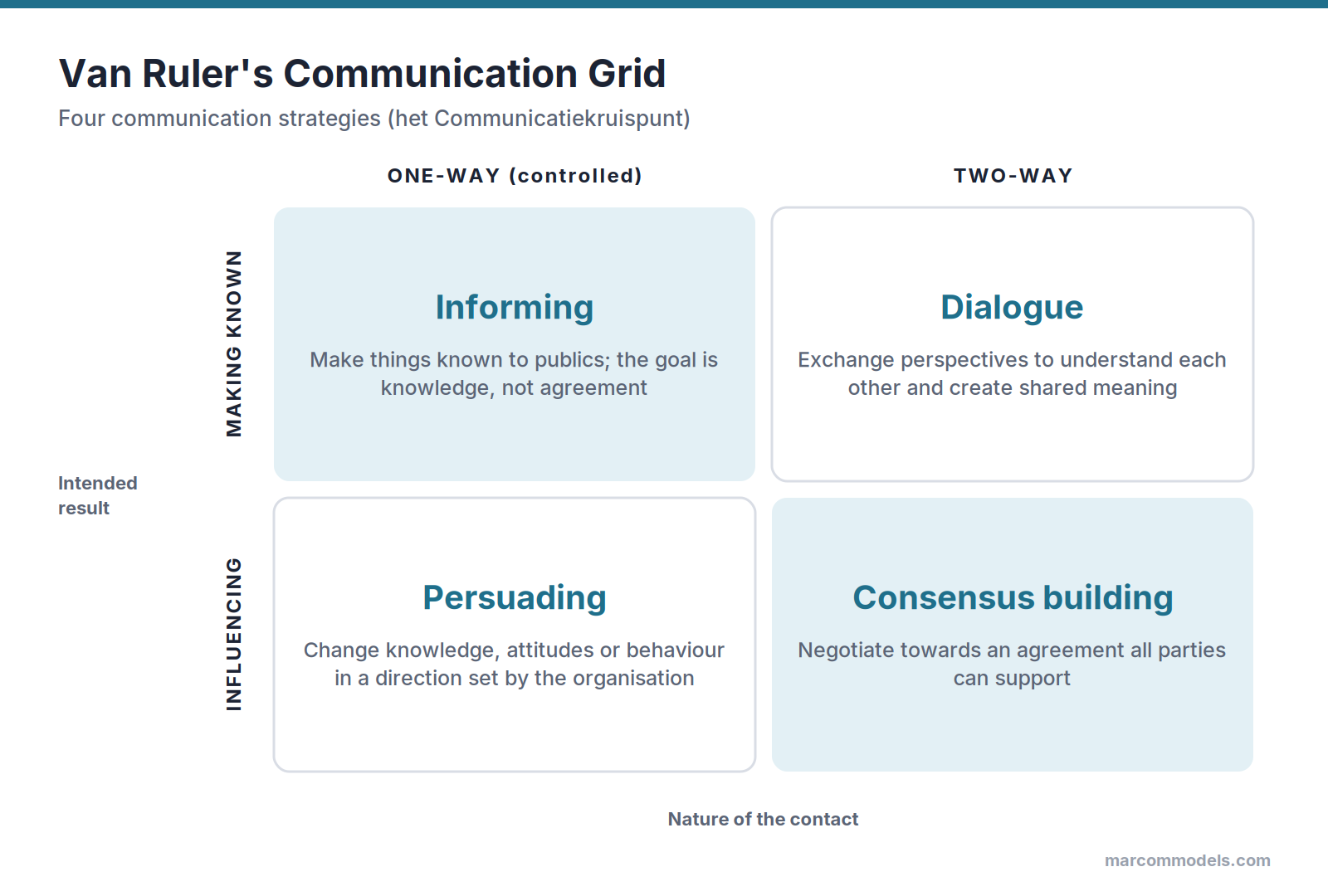
The grid is based on two dimensions:
- The nature of the contact: is communication controlled one-way traffic from the organisation to its publics, or two-way traffic in which both parties contribute?
- The intended result: does the organisation want to make something known, or does it want to influence the other party?
Combining these dimensions creates four communication strategies:
- Informing (one-way, making known). The organisation provides clear and accessible information so that publics know what is going on, for example about a new procedure. The goal is knowledge, not agreement.
- Persuading (one-way, influencing). The organisation tries to change the knowledge, attitudes or behaviour of publics in a direction it has determined itself, as in advertising or behaviour change campaigns.
- Dialogue (two-way, making known). Parties exchange perspectives to understand each other and create shared meaning, without the outcome being fixed in advance.
- Consensus building (two-way, influencing). Parties negotiate to reach an agreement or a decision they can all support, as in participation processes.
The model connects to Grunig and Hunt’s (1984) models of public relations, which distinguish asymmetrical and symmetrical communication. Cornelissen (2020) similarly distinguishes informational, persuasive and dialogue strategies in corporate communication. Van Ruler adds that each strategy has its own theories and conditions under which it works, and that no strategy is inherently better than another.
Applications of the Communication Grid
The grid is used to determine, for each issue, stakeholder or project phase, which strategy fits best. A change process in an organisation, for example, might start with dialogue to explore concerns, move towards consensus building about the approach, and end with informing employees about the final arrangements.
In the Strategic Communication Frame (Van Ruler & Körver, 2019), the grid is one of the tools for making strategic choices. It is also used in public sector communication, where many policy projects require participation of citizens, and in issue management, where the choice between informing, persuading and dialogue determines the organisation’s position in a public debate.
Criticism
The grid is a simplification. In practice, strategies overlap: an informative campaign often also has a persuasive intention, and dialogue can be part of a persuasion strategy.
The model assumes that the organisation chooses the strategy. In a networked media environment, stakeholders themselves decide whether communication becomes two-way; truly controlled one-way communication hardly exists anymore once publics can respond publicly online.
Finally, the model has been used and discussed mostly in the Dutch context, and it has received less international empirical testing than, for example, Grunig’s models.
Misuse and Flaws Compared to Similar Models
- Pseudo-dialogue. Calling a meeting “dialogue” or “participation” while the decision has already been made undermines trust. If the outcome is fixed, informing or persuading is the more honest strategy.
- Always choosing the same quadrant. Many organisations default to informing or persuading. The grid is meant to make a deliberate choice for each situation.
- Treating the grid as a hierarchy. Two-way strategies are not automatically better. Informing is the most effective strategy when people simply need clear information.
Conclusion
Van Ruler’s communication grid offers a simple yet powerful tool for choosing between informing, persuading, dialogue and consensus building. By linking the nature of the contact to the intended result, it helps professionals make conscious strategic choices and explain those choices to clients. Its value lies not in the four boxes themselves, but in the question it forces professionals to ask: what kind of communication does this situation really need?
References
Cornelissen, J. (2020). Corporate communication: A guide to theory and practice (6th ed.). Sage.
Grunig, J. E., & Hunt, T. (1984). Managing public relations. Holt, Rinehart and Winston.
Van Ruler, A. A. (1998). Strategisch management van communicatie: Introductie van het communicatiekruispunt. Samsom.
Van Ruler, B. (2004). The communication grid: An introduction of a model of four communication strategies. Public Relations Review, 30(2), 123–143.
Van Ruler, B., & Körver, F. (2019). The communication strategy handbook: Toolkit for creating a winning strategy. Peter Lang.