
Introduction
Hierarchy-of-effects models describe the steps a consumer is assumed to go through between first exposure to a marketing communication and the final purchase. They share one core idea: communication does not lead to sales directly, but through a sequence of cognitive (thinking), affective (feeling) and conative (doing) responses.
These models are among the oldest in marketing communications and still form the basis for setting communication objectives and measuring advertising effects. This article discusses the best-known models, the alternative sequences described by De Pelsmacker et al. (2021), and the criticism the approach has received.
Overview of Hierarchy-of-Effects Models
AIDA. The oldest and best-known model is AIDA: Attention, Interest, Desire, Action. It is usually attributed to the advertising pioneer E. St. Elmo Lewis around 1900, although the exact origin is debated.
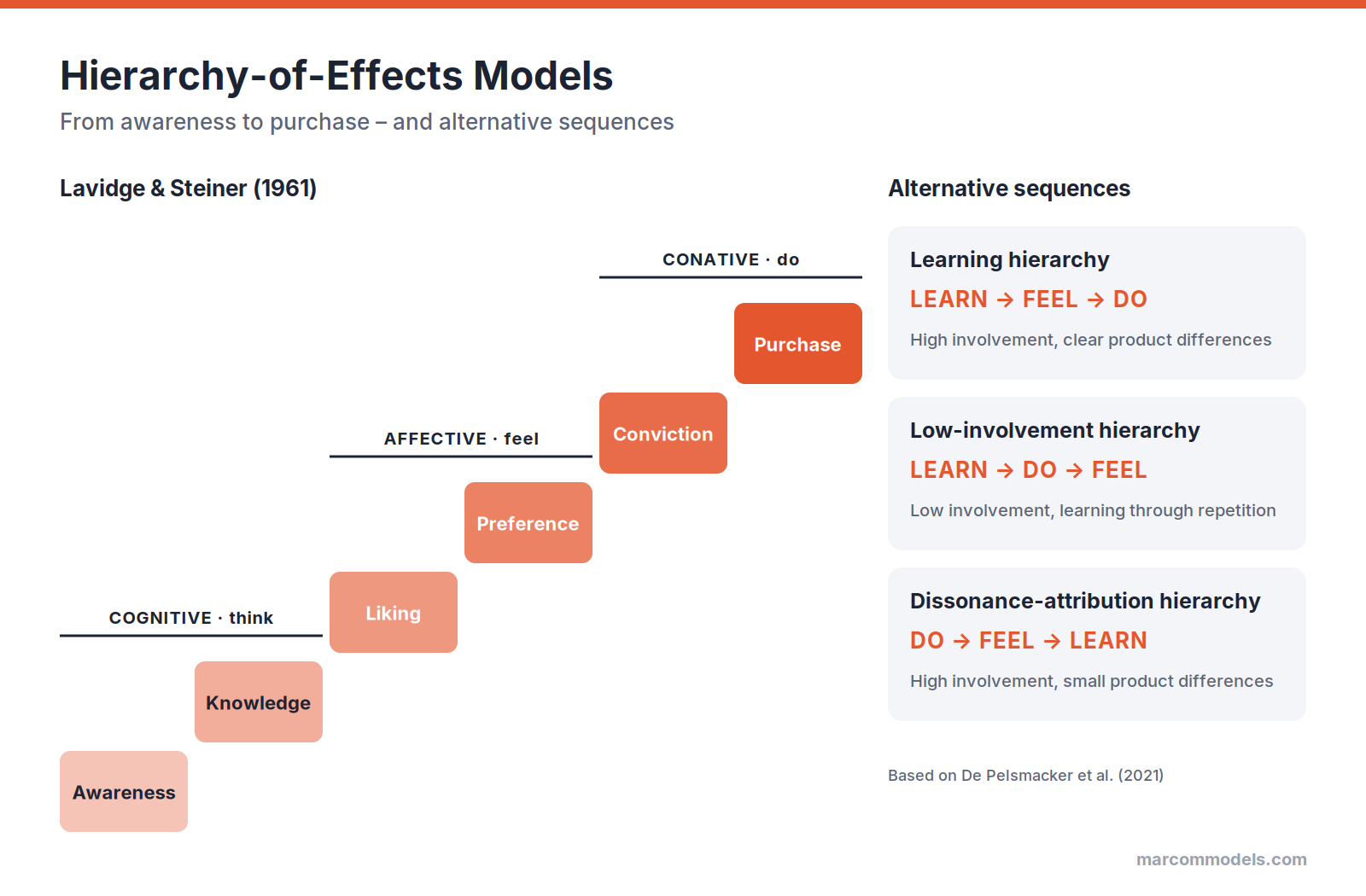
Lavidge and Steiner (1961). This model describes six steps: awareness, knowledge, liking, preference, conviction and purchase. The steps are grouped into three stages:
- Cognitive (awareness, knowledge) – think
- Affective (liking, preference) – feel
- Conative (conviction, purchase) – do
DAGMAR. Colley (1961) introduced Defining Advertising Goals for Measured Advertising Results, with the steps awareness, comprehension, conviction and action. The key contribution of DAGMAR is the idea that communication objectives must be specific and measurable, and that advertising should be judged on communication effects rather than on sales alone.
Alternative sequences. The classic order think–feel–do assumes a highly involved consumer. De Pelsmacker et al. (2021) describe several alternative hierarchies, depending on involvement and the type of product:
- Learning hierarchy (learn–feel–do) – high involvement and clear product differences, for example buying a car.
- Low-involvement hierarchy (learn–do–feel) – based on Krugman (1965): through repetition, consumers learn a brand name almost passively, buy the product, and only form an attitude after using it.
- Dissonance-attribution hierarchy (do–feel–learn) – consumers buy first, then develop an attitude, and afterwards seek information that confirms their choice (compare cognitive dissonance theory).
The FCB grid. Vaughn (1980) combined involvement (high/low) with the type of processing (think/feel) into four quadrants, each with its own sequence: informative (learn–feel–do), affective (feel–learn–do), habitual (do–learn–feel) and self-satisfaction (do–feel–learn). The Rossiter-Percy grid refines this by distinguishing informational and transformational purchase motives.
Applications of Hierarchy-of-Effects Models
The models are mainly used to formulate communication objectives. Instead of the vague objective “more sales”, a campaign might aim for a higher level of brand awareness, a change in attitude or an increase in purchase intention within a defined target group. These objectives can be measured through pretesting and posttesting.
The models also help in choosing media and messages. Awareness is often built with reach-oriented media, while persuasion and action require more information-rich or interactive media. Finally, the models connect to the customer journey: each stage of the journey requires different communication effects.
Criticism
Vakratsas and Ambler (1999) reviewed over 250 studies and found little evidence of a fixed hierarchy. Effects of advertising do not necessarily occur in a set order; cognition, affect and experience interact.
Zajonc (1980) showed that affective reactions can occur without prior cognition, which contradicts the idea that consumers always think before they feel. This is particularly relevant for low-involvement products and emotional advertising.
The models also end at the purchase, while repeat purchases, loyalty and word of mouth are often more important. In a digital environment, where consumers encounter brands in many ways at the same time, a linear model offers only a limited picture of reality.
Misuse and Flaws Compared to Similar Models
- Taking the steps literally. The models are simplifications. Assuming that every consumer passes through every step in order leads to rigid campaign planning.
- Using AIDA for every product. The classic hierarchy fits high-involvement purchases. For low-involvement products, repetition and brand familiarity often matter more than persuasive arguments.
- Measuring only the first step. Campaigns that are evaluated only on awareness or reach say little about the actual effect on attitude and behaviour.
- Confusing with the customer journey. Hierarchy-of-effects models describe psychological responses to communication from the sender’s perspective; the customer journey describes the customer’s full experience across touchpoints.
Conclusion
Hierarchy-of-effects models remain useful for structuring communication objectives and thinking about how advertising works. Their main value lies in distinguishing cognitive, affective and conative effects. At the same time, research shows that there is no universal sequence: the right hierarchy depends on involvement, product type and context.
References
Barry, T. E., & Howard, D. J. (1990). A review and critique of the hierarchy of effects in advertising. International Journal of Advertising, 9(2), 121–135.
Colley, R. H. (1961). Defining advertising goals for measured advertising results. Association of National Advertisers.
De Pelsmacker, P., Geuens, M., & Van den Bergh, J. (2021). Marketing communications: A European perspective (7th ed.). Pearson.
Krugman, H. E. (1965). The impact of television advertising: Learning without involvement. Public Opinion Quarterly, 29(3), 349–356.
Lavidge, R. J., & Steiner, G. A. (1961). A model for predictive measurements of advertising effectiveness. Journal of Marketing, 25(6), 59–62.
Vakratsas, D., & Ambler, T. (1999). How advertising works: What do we really know? Journal of Marketing, 63(1), 26–43.
Vaughn, R. (1980). How advertising works: A planning model. Journal of Advertising Research, 20(5), 27–33.
Zajonc, R. B. (1980). Feeling and thinking: Preferences need no inferences. American Psychologist, 35(2), 151–175.