
Introduction
Every organisation presents itself to its stakeholders, whether it does so deliberately or not. The corporate identity mix, developed by the German authors Birkigt and Stadler (1986), describes how an organisation expresses its identity. It became widely known in Europe through the work of Van Riel (1995) and is one of the core models in corporate communication textbooks such as Cornelissen’s Corporate Communication.
This article explains the four elements of the corporate identity mix, the related concepts of corporate image and corporate reputation, and the ways the model is applied and criticised.
Overview of the Corporate Identity Mix
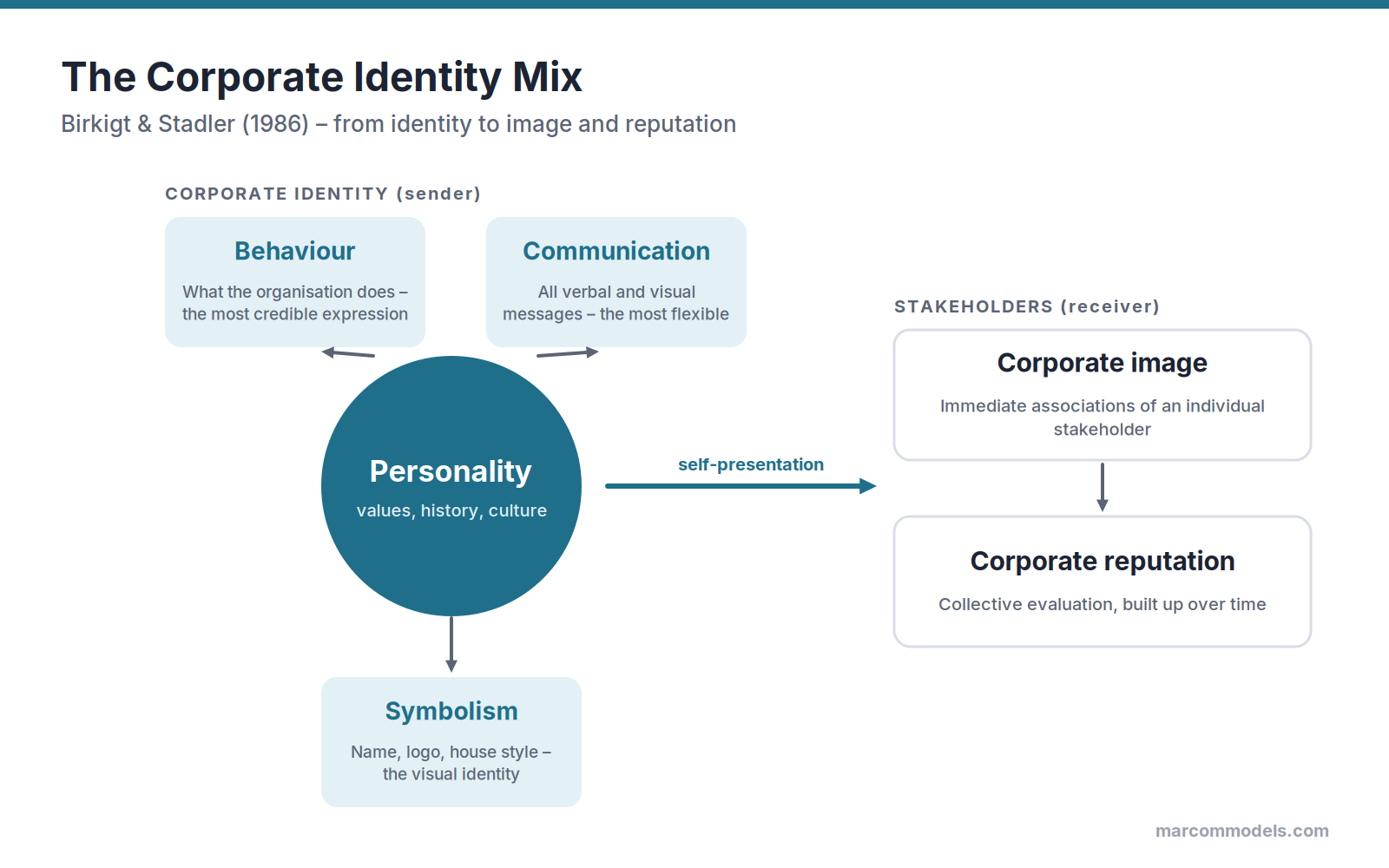
Corporate identity refers to the self-presentation of an organisation: the way it presents itself to internal and external stakeholders. According to Birkigt and Stadler, this self-presentation is expressed through three means, all rooted in the organisation’s personality:
- Personality – the core of the organisation: its values, intentions, history and culture. Personality is the source from which the other elements should flow.
- Behaviour – everything the organisation does: how it treats customers and employees, the quality of its products, its decisions and actions. Behaviour is regarded as the most important and most credible expression of identity, because stakeholders judge organisations mainly by what they do.
- Communication – all verbal and visual messages the organisation sends, from advertising and press releases to the website and annual report. Communication is the most flexible element and can be used most quickly.
- Symbolism – the visual identity: name, logo, house style, colours, typography, architecture and uniforms. Symbolism should reflect and support the other elements.
Identity, image and reputation. Cornelissen (2020) distinguishes three related concepts. Corporate identity is the profile and values the organisation communicates. Corporate image is the immediate set of associations an individual stakeholder has in response to messages from the organisation. Corporate reputation is the collective, long-term evaluation of an organisation by its stakeholders, built up over time. Identity is on the sender’s side; image and reputation are on the receiver’s side.
Schools of thought. Van Riel and Balmer (1997) note that the concept of corporate identity evolved from a graphic design perspective (focused on logos and house style), via an integrated communication perspective, to an interdisciplinary perspective in which identity concerns the whole organisation, including strategy and culture.
Applications of the Corporate Identity Mix
The model is used to analyse whether the four elements of an organisation are consistent. An identity audit examines whether symbolism, communication and behaviour express the same personality. Inconsistencies – for example a sustainable image in advertising combined with unsustainable business practices – undermine credibility.
The model is also used in rebranding and mergers, where a new identity must be expressed in all elements, and in employer branding, where employees are both the carriers and the audience of the identity. It helps communication professionals explain to management that communication and a new logo alone cannot change how an organisation is perceived.
Criticism
The model has been criticised for its sender-oriented and rather static view. It suggests that management can determine and control identity, whereas identity is also shaped by employees, stakeholders and the media. Hatch and Schultz (1997) argue that organisational identity, culture and image are closely intertwined and influence each other continuously.
The concept of personality is also vaguely defined and overlaps strongly with organisational culture. Moreover, large organisations often have multiple identities, for example in different countries or business units, which the model does not explicitly address.
Misuse and Flaws Compared to Similar Models
- Reducing identity to symbolism. Treating corporate identity as a matter of logos and house style ignores the elements that matter most to stakeholders: behaviour and communication.
- Communicating an identity that does not match behaviour. Claims about values that are not reflected in actual behaviour lead to accusations of greenwashing or “purpose-washing”.
- Confusing identity and image. Organisations sometimes assume their stakeholders see them as they see themselves. Only research among stakeholders can show the actual image.
Conclusion
The corporate identity mix remains a clear and practical model for analysing how organisations present themselves. Its central message – that behaviour, communication and symbolism should all flow from the same personality – is as relevant as ever. Combined with research into image and reputation, it helps organisations close the gap between who they say they are and how they are perceived.
References
Birkigt, K., & Stadler, M. M. (1986). Corporate identity: Grundlagen, Funktionen, Fallbeispiele. Verlag Moderne Industrie.
Cornelissen, J. (2020). Corporate communication: A guide to theory and practice (6th ed.). Sage.
Hatch, M. J., & Schultz, M. (1997). Relations between organizational culture, identity and image. European Journal of Marketing, 31(5/6), 356–365.
Van Riel, C. B. M. (1995). Principles of corporate communication. Prentice Hall.
Van Riel, C. B. M., & Balmer, J. M. T. (1997). Corporate identity: The concept, its measurement and management. European Journal of Marketing, 31(5/6), 340–355.