
Introduction
In change processes, organisations often rely on emails, newsletters and intranet messages to inform employees. Yet a message in a newsletter rarely leads to real commitment. Bill Quirke, a British consultant specialising in internal communication, developed the communication escalator to show that different communication goals require different forms of communication. In the Netherlands the model is widely known as de Trap van Quirke.
The model is used in internal and change communication and appears in the corporate communication curriculum alongside other models for internal communication. This article explains the steps of the escalator, how to apply it and its limitations.
Overview of the Communication Escalator
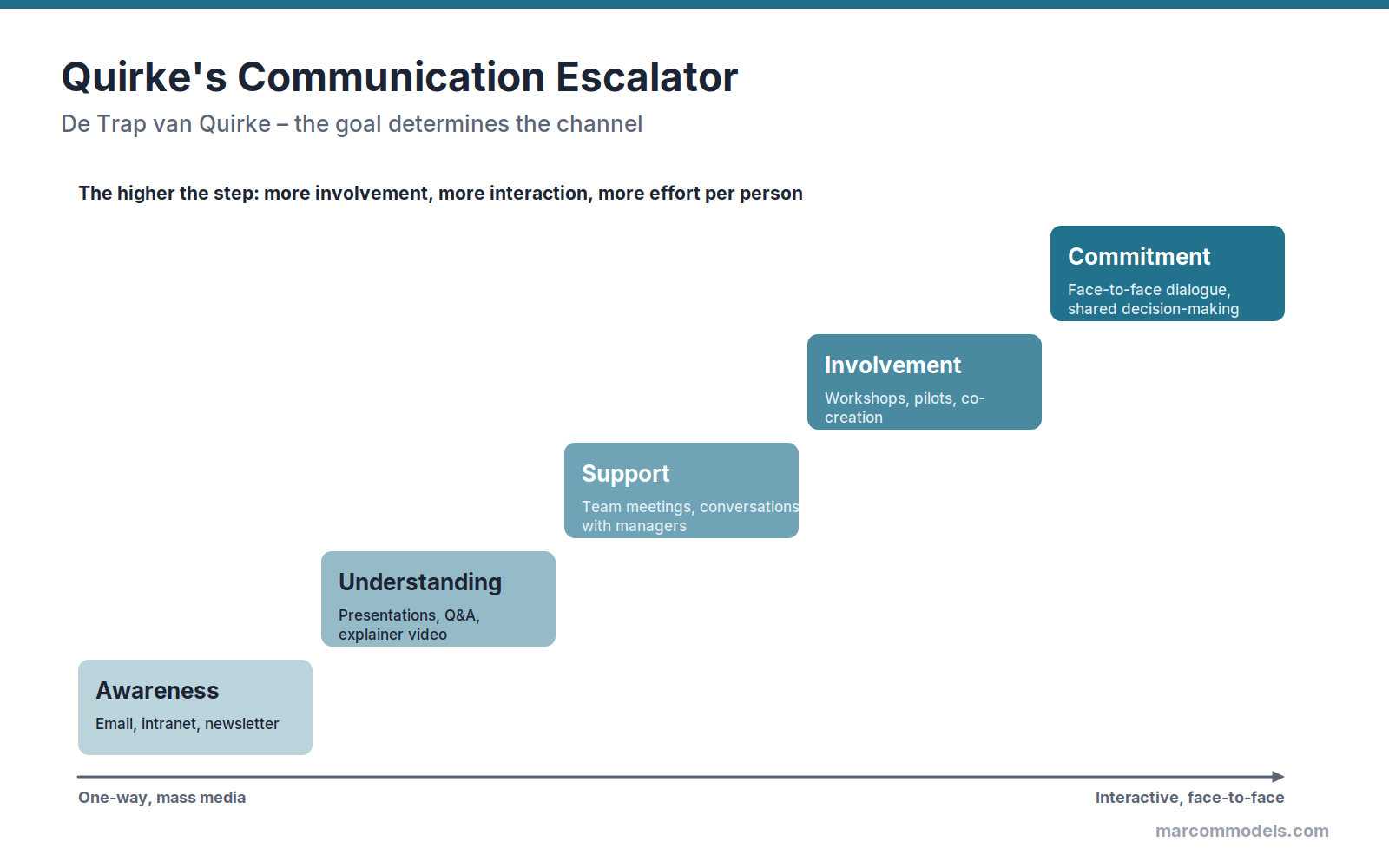
Quirke (1995, 2008) describes the escalator as a series of steps that employees – or other stakeholders – go through in a change process. Each step requires more involvement from the receiver:
- Awareness – people know that something is going to change.
- Understanding – people understand what the change means and why it is necessary.
- Support – people have a positive attitude towards the change and accept it.
- Involvement – people actively participate, for example by contributing ideas or taking part in pilots.
- Commitment – people take ownership of the change and champion it to others.
Channels per step. The core insight of the model is that the higher the step, the more interactive and personal the communication must be. For awareness, one-way media such as email, intranet and newsletters are efficient. For understanding, explanatory presentations and Q&A sessions are needed. Support and involvement require dialogue: team meetings, workshops and conversations with direct managers. Commitment can only be achieved through face-to-face interaction and genuine participation in decision-making.
As a result, the costs and effort of communication increase with each step, while the number of people who can be reached at the same time decreases. Organisations must therefore decide which level they need to achieve with which groups.
Applications of the Communication Escalator
The escalator is used to plan internal and change communication. Communication professionals determine, per stakeholder group, which level is required: not every employee needs to be committed to every change, but key figures such as middle managers usually do. The model then helps to choose appropriate channels and to plan the process over time.
The model connects to downward and upward communication: the higher steps require upward communication and dialogue. It also fits well with Van Ruler’s communication grid: the lower steps correspond to informing, while the higher steps require dialogue and consensus building. For behaviour change, it can be combined with the CASI model.
Criticism
The escalator suggests a linear process, while in practice people can support a change without fully understanding it, or understand it perfectly and still resist it. Emotions, trust and the relationship with management play a major role that the model does not explicitly address.
The model also focuses on the communication process and says little about the content of the change itself. If a change is poorly designed, no amount of face-to-face communication will lead to commitment. Finally, the model is based on practical experience rather than empirical research.
Misuse and Flaws Compared to Similar Models
- Expecting commitment from one-way communication. A launch email or video cannot achieve more than awareness, no matter how well it is made.
- Aiming for commitment from everyone. Striving for the highest step with all employees is unrealistic and expensive. Choose the required level per group.
- Pseudo-involvement. Inviting employees to “participate” when decisions have already been made undermines trust and can increase resistance.
Conclusion
Quirke’s communication escalator offers a simple but powerful insight: the goal of communication determines the means. Moving from awareness to commitment requires increasingly personal and interactive communication. For communication professionals in change processes, the model helps to set realistic goals per stakeholder group and to choose channels that fit those goals.
References
Quirke, B. (1995). Communicating corporate change: A practical guide to communication and corporate strategy. McGraw-Hill.
Quirke, B. (2008). Making the connections: Using internal communication to turn strategy into action (2nd ed.). Gower.
Welch, M., & Jackson, P. R. (2007). Rethinking internal communication: A stakeholder approach. Corporate Communications: An International Journal, 12(2), 177–198.