
Introduction
Why do people buy a product because “everyone else has it”, or agree to a request because someone did them a small favour first? Social psychologist Robert Cialdini studied these questions for decades, partly by working undercover as a salesperson, fundraiser and advertiser. In his book Influence (first published in 1984) he described six principles of persuasion; in the revised edition (Cialdini, 2021) he added a seventh.
The principles are among the most frequently used insights from social psychology in marketing, fundraising and behaviour change. This article explains each principle, discusses applications and criticism, and pays attention to the ethical limits of their use.
Overview of the Principles of Persuasion
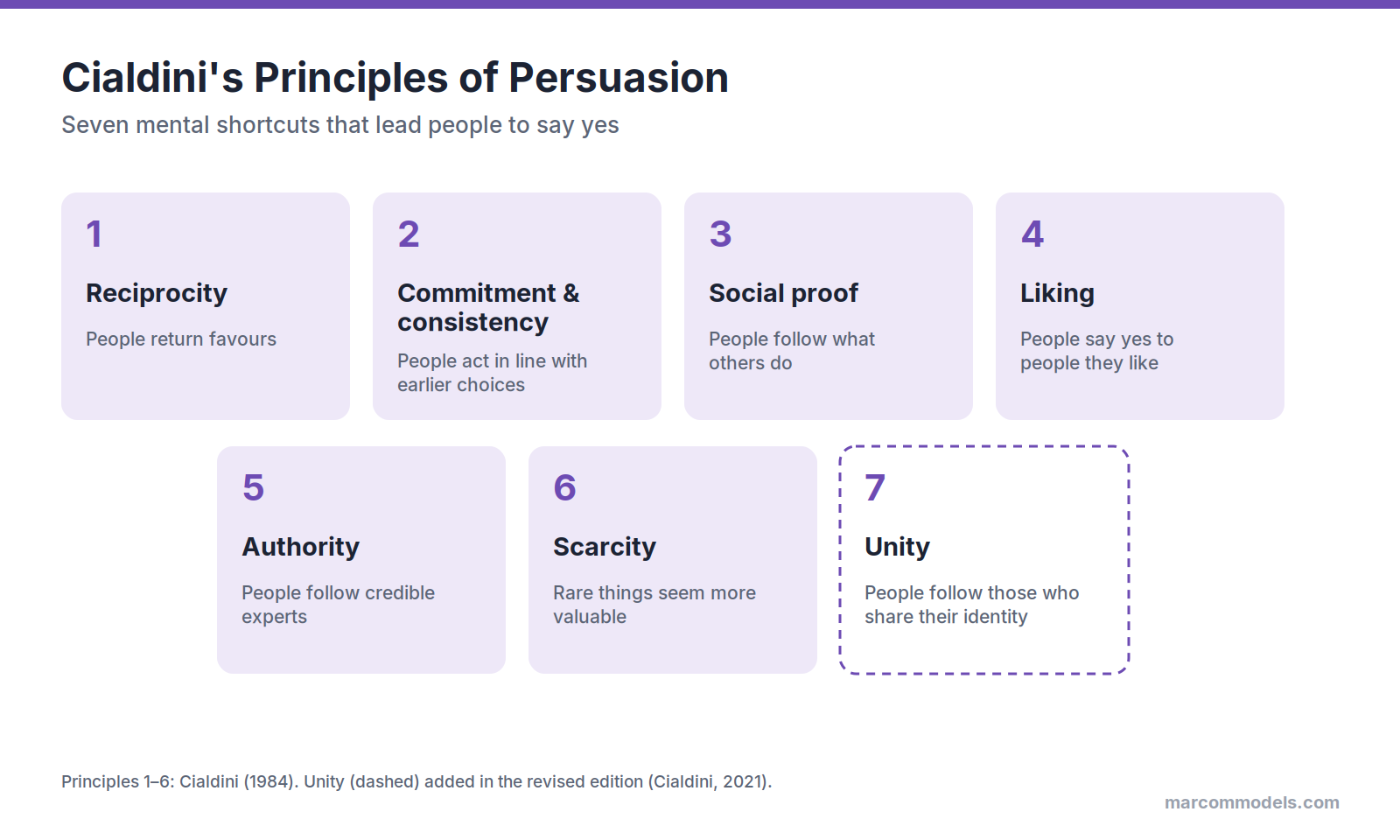
Cialdini’s starting point is that people use mental shortcuts (heuristics) to make decisions quickly in a complex world. Usually these shortcuts serve people well, but they can also be exploited. The seven principles are:
- Reciprocity – people feel obliged to return favours. A free sample, a useful gift or a helpful piece of advice increases the likelihood that people will do something in return.
- Commitment and consistency – people want to act consistently with what they have said or done before. Someone who agrees to a small request is more likely to agree to a larger one later (the foot-in-the-door technique; Freedman & Fraser, 1966).
- Social proof – when uncertain, people look at what others do. Reviews, ratings and messages such as “most guests reuse their towels” influence behaviour. In a well-known field study, hotel guests reused their towels more often when told that most other guests did so (Goldstein, Cialdini & Griskevicius, 2008).
- Liking – people say yes more easily to people they like. Similarity, compliments, attractiveness and cooperation increase liking.
- Authority – people tend to follow credible experts. Titles, uniforms and demonstrated expertise increase compliance.
- Scarcity – things become more attractive when they are rare or when availability is limited. “Only three left” and “offer valid until Sunday” use this principle.
- Unity – people are more easily persuaded by those they perceive as part of the same group or identity (“people like us”), such as family, fellow residents or members of a community.
These principles connect to other theories on this site, including normative and informational social influence (social proof), cognitive dissonance (commitment and consistency) and reactance theory, which explains why scarcity tactics can backfire when people feel their freedom is threatened.
Applications of the Principles
In marketing and sales, the principles are used in advertising, web design and conversion optimisation, for example through customer reviews (social proof), expert endorsements (authority) and limited-time offers (scarcity). In fundraising, small gifts and personal requests are applied to increase donations.
The principles are also widely used in behaviour change and public communication. Descriptive norm messages (“most people in your street already separate their waste”) are used to encourage sustainable or healthy behaviour, and commitment techniques help people stick to their intentions. In intervention development, the principles can be used as practical persuasion techniques within a broader framework such as intervention mapping.
Criticism
The principles are a practical classification rather than a single, coherent theory. They are not exhaustive, they overlap in places, and the list does not explain when one principle is more effective than another.
Their effectiveness depends strongly on context, culture and the relationship between sender and receiver. Some effects found in laboratory studies are smaller in real-world settings, and the broader replication debate in social psychology has also raised questions about the strength of some classic findings (Cialdini & Goldstein, 2004 provide a review of the underlying research).
Finally, there is an ethical tension: the same principles that help people make better decisions can be used to manipulate them into choices that are not in their interest.
Misuse and Flaws Compared to Similar Theories
- Dark patterns. Fake scarcity (“only 1 room left!”), fabricated reviews and countdown timers that reset are misuse of the principles. Such practices damage trust and may violate consumer protection law in the EU.
- Using principles as tricks instead of strategy. Stacking persuasion techniques on a weak proposition can lead to short-term conversions but damages brand trust in the long run.
- Ignoring reactance. Overly pushy use of scarcity or authority can provoke resistance, especially among people who value their autonomy.
Conclusion
Cialdini’s principles of persuasion offer a clear and practical framework for understanding why people comply with requests. They are useful for marketing, fundraising and behaviour change, provided they are applied ethically and in the right context. The central question for communication professionals is not only whether a principle works, but whether its use respects the interests and autonomy of the audience.
References
Cialdini, R. B. (2021). Influence, new and expanded: The psychology of persuasion. Harper Business.
Cialdini, R. B., & Goldstein, N. J. (2004). Social influence: Compliance and conformity. Annual Review of Psychology, 55, 591–621.
Freedman, J. L., & Fraser, S. C. (1966). Compliance without pressure: The foot-in-the-door technique. Journal of Personality and Social Psychology, 4(2), 195–202.
Goldstein, N. J., Cialdini, R. B., & Griskevicius, V. (2008). A room with a viewpoint: Using social norms to motivate environmental conservation in hotels. Journal of Consumer Research, 35(3), 472–482.